A handheld console warranty is a written promise from the maker or seller to repair or replace the device if it fails because of a defect. In the U.S., one year is the usual length. What matters more than the length is what the paper excludes, who you have to call, and what proof you need. This guide walks through all three, then shows how the warranty on our Retro Pulse handheld works.
TL;DR
- A typical manufacturer warranty on consumer electronics lasts one year, though some run as short as 90 days or as long as 24 months.
- Federal law says a written warranty must be available to read before you buy. Read it, especially the exclusions and the claim process.
- Keep your receipt. Registration is often optional, but proof of purchase is what verifies your dates.
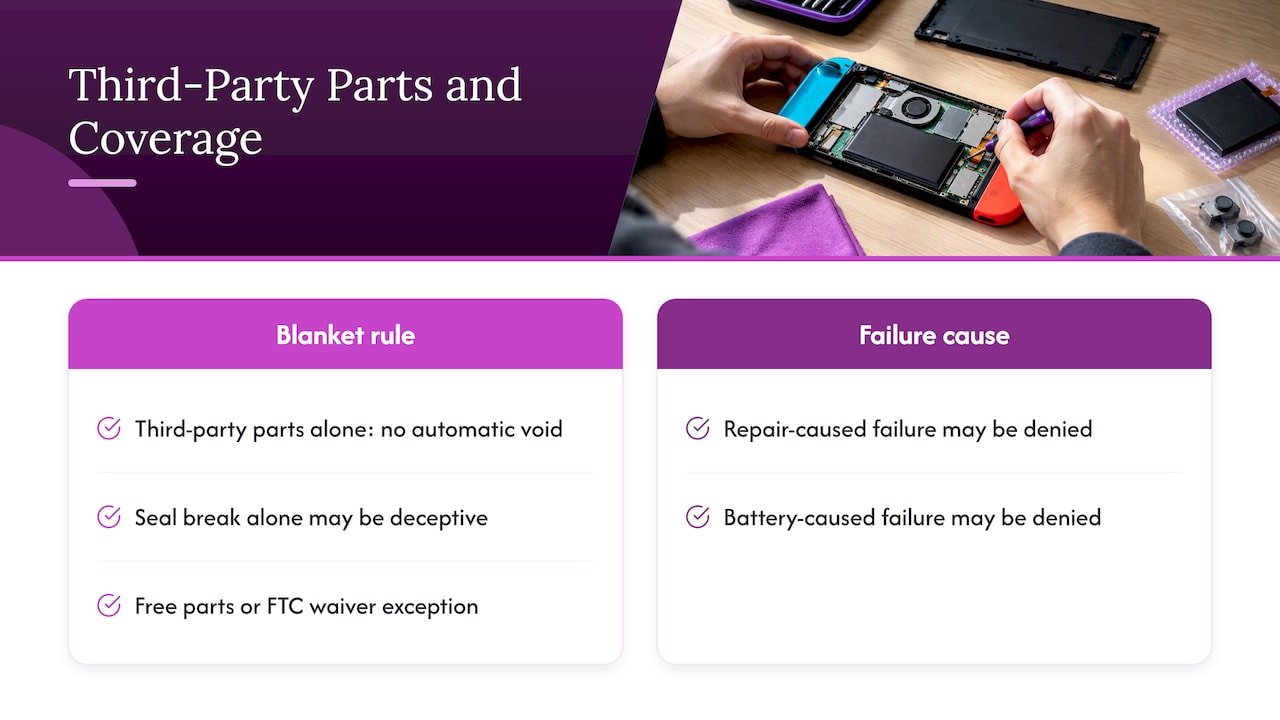
- A seller generally cannot void your warranty just because you used third-party parts or services, unless it provides them free or gets an FTC waiver.
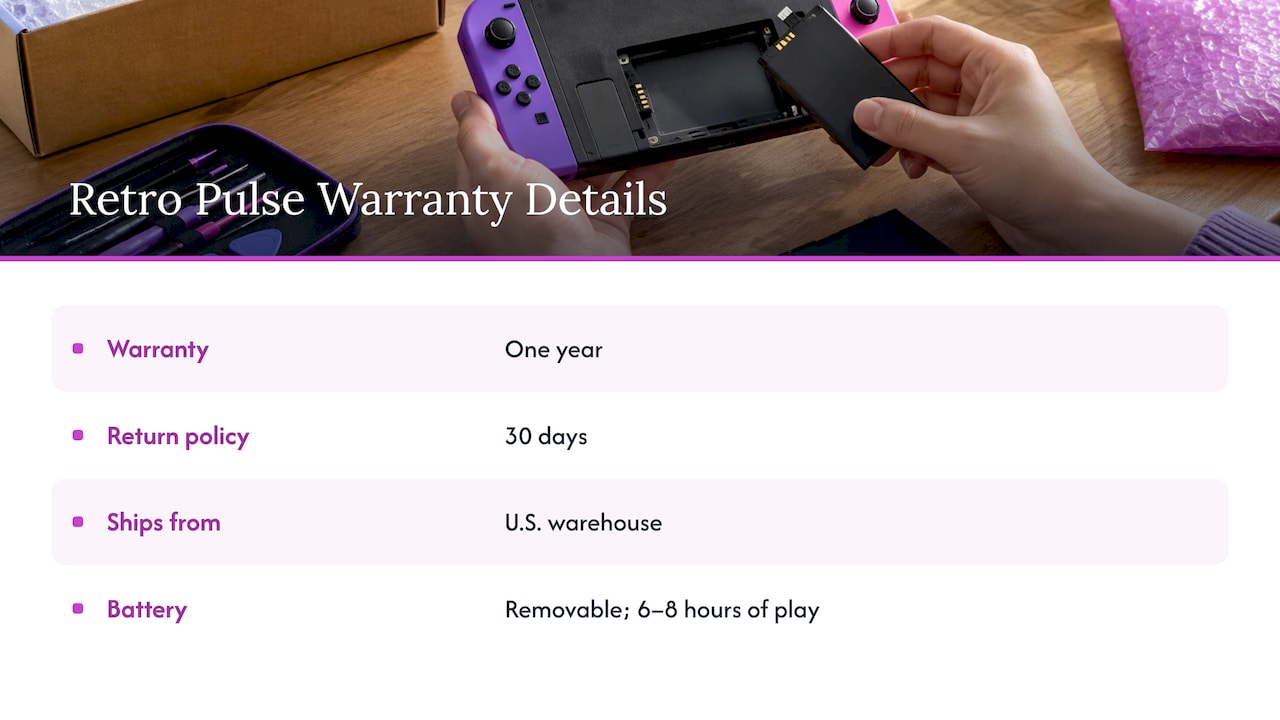
- Retro Pulse comes with a 1-year warranty and 30-day returns, shipped from a U.S. warehouse.
Table of Contents
- What a handheld warranty actually is
- How long should a handheld console warranty be?
- What handheld warranties usually leave out
- Will using third-party parts void it?
- Why the seller matters as much as the maker
- The Retro Pulse warranty
- Ready to try a handheld with a U.S. warranty?
- Our view: warranty is the part of the spec sheet nobody reads
- How to file a handheld warranty claim
- Should you buy an extended warranty?
- Buying used or refurbished
- A pre-purchase checklist
- FAQ
- Sources
What a handheld warranty actually is
Under federal law, a “written warranty” is a written promise or affirmation made when a consumer product is sold, relating to the material or workmanship of the product. The definition sits in Title 15 of the U.S. Code. In plain terms: if the seller or maker puts a promise in writing, that promise is the warranty, and it has to say what it means.
For a handheld, that promise normally covers defects in materials and workmanship. A screen that develops dead pixels on its own, a charging port that stops working under normal use, or a button that fails without being abused are the kind of problems a warranty is built for. A dropped device, a cracked case or a cup of coffee in the shell are not.
Two other things are worth knowing:
- Warranties are not guarantees of lifespan. The FTC explains that implied warranties are promises about a product’s condition at the time of sale, not promises that it will last a set number of years.
- Warranty and return window are different things. A return window lets you send back a device you simply don’t like. A warranty covers a device that breaks. You want both, and you should know which one you are using.
How long should a handheld console warranty be?
Consumer Action’s guide to device warranties says a typical manufacturer warranty lasts one year, with some as short as 90 days and some as long as 24 months. That is a good yardstick for handhelds too. A one-year term is standard. Anything shorter than that deserves a question: why is the seller less confident than the norm?
Length alone is a weak signal, though. A two-year warranty that requires you to ship the device overseas at your own cost can be worth less than a one-year warranty handled by a U.S. team that answers email. Compare the terms on five points:
| What to check | Why it matters | A good answer looks like |
|---|---|---|
| Term | Sets the clock on your claim | 12 months or more, starting on a clear date |
| Start date | Some start at purchase, some at shipping | Stated in writing |
| Who you contact | Maker, store, or both | One named channel with a real email or form |
| Exclusions | Cosmetic damage and accidents are usually out | Short, specific list, not vague wording |
| Remedy | Repair, replace or refund | Stated, with who pays shipping |
What handheld warranties usually leave out
The FTC’s warranty guidance and Consumer Action both say to look for what is excluded, such as cosmetic issues or accidental damage. For a handheld console, these are the usual gray areas:
- Drops and liquid. Almost every warranty excludes physical impact and water damage. Cases and screen protectors cost far less than a repair.
- Cosmetic wear. Scuffs on the shell, worn rubber on the thumbsticks and faded button paint are normal use, not defects.
- Batteries. Batteries lose capacity with age. Many warranties cover a battery that fails early or swells, but not the slow loss of runtime you notice after a year or two. Check whether the battery is named in the document.
- Stick drift and button wear. These are the parts you use the most. Ask whether input components are covered, and for how long.
- Software you added. Games, firmware changes and settings you installed yourself are often outside the warranty. A seller may reasonably decline to troubleshoot a library you modified, even if the hardware stays covered.
- Storage cards. A microSD card is usually sold and covered separately from the handheld itself.
The battery point matters for heat too. If your device runs hot, see our guide to retro handheld overheating, safe fixes and battery risks before you assume it is a defect.
Will using third-party parts void it?
Not automatically, and a lot of sellers get this wrong. In 2018 the FTC sent warning letters to companies whose statements said consumers must use specified parts or service providers to keep a warranty intact. Under the Magnuson-Moss Warranty Act, a company cannot condition coverage on specific brand-name parts or services unless it provides them free of charge or receives a waiver from the FTC. The same FTC release says that claiming a warranty is voided simply by using third-party parts or breaking a warranty seal may be deceptive.
That does not mean anything goes. If a third-party battery or a bad repair causes the failure, the seller can reasonably deny that specific claim. The rule is about blanket threats, not about the cause of a particular failure.
This is relevant to retro handhelds because modding is part of the hobby. Adding games through a card slot, swapping a battery, or changing a shell are all common. A fair warranty separates “you did something that caused damage” from “you touched it, so nothing is covered.”
Why the seller matters as much as the maker
With a handheld from a large console brand, the warranty is backed by a corporation with U.S. service centers. With a small-brand handheld, the paper can look similar but the experience varies enormously. The questions to ask before you buy:
- Where is the stock? A device shipped from a domestic warehouse can be exchanged in days. One that has to go back overseas can take weeks.
- Who answers? Look for a named support channel and a policy page, not just a marketplace messaging box.
- What is the return window? A 30-day return period gives you time to test the device properly, including battery life and the controls.
- Is the library legit and safe? Our piece on preloaded consoles and the three risks to check covers what to look at before you trust any preloaded device.
This is the reasoning behind how we ship Retro Pulse from a U.S. warehouse. It avoids the long waits and quality gaps that often come with purchases from overseas suppliers.
The Retro Pulse warranty
Here is what we can say, plainly. Retro Pulse is covered by a one-year warranty and a 30-day return policy. It ships from a U.S. warehouse. The handheld has a 3.5" IPS display, a real D-pad, twin sticks and L/R triggers, USB-C charging, and a removable battery rated at 6 to 8 hours of play. Two microSD slots let you add games of your own.
The removable battery is a practical warranty feature, even though it is not one on paper. A battery you can swap yourself is easier to replace than one soldered inside a sealed case, which means a worn battery does not have to end the life of the device.
For the exact return steps and conditions, read our refund policy before you order. That is the document that governs a return, and it is yours to read before you pay, as the FTC advises for any warranty or policy.
Ready to try a handheld with a U.S. warranty?
If you want a handheld that is ready to play out of the box, with 15,000 classic games from more than 20 systems, no downloads and no subscription, look at Retro Pulse. It comes with a one-year warranty, 30-day returns and shipping from our U.S. warehouse. You can also see the whole range on our handhelds page.
Our view: warranty is the part of the spec sheet nobody reads
We sell a handheld, so we see how people shop. They compare screen size, game counts and battery hours. Almost nobody compares warranties until something breaks, and by then it is the only thing that matters.
Here is what we think after watching this category. First, a warranty is a statement of how much a seller trusts its own product. If a company will not put a clear term in writing, treat that as information. Second, the support path counts more than the headline term. A one-year promise handled from a U.S. warehouse, with a 30-day return window to catch early problems, beats a longer promise nobody answers. Third, most defects show up early. That is why a return window and a warranty belong together: the first month tells you most of what you need to know.
We also think handheld buyers deserve plain language. Parents buying a gift, students on a budget and commuters who need a device that works on the train do not want to decode legal wording. So test the device right away, keep the receipt, and write to support the moment something seems off. We would rather hear about a problem in week two than month eleven.
— Sean
How to file a handheld warranty claim
When something goes wrong, the order of steps matters.
- Stop and document. Take a short video of the problem. Note the date, what you were doing and whether it happens every time.
- Find your proof of purchase. Consumer Action notes that many makers do not require registration, but you need a receipt or bill of sale to verify the date and your eligibility. Save the order email as a PDF now, before you need it.
- Read the claim process. The warranty states whether you contact the maker directly or go back to the seller. Follow that route exactly, as the FTC advises.
- Report it right away. Consumer Action advises reporting defects immediately. Companies may sometimes honor repairs for widespread issues even after a warranty expires, especially when you reported promptly.
- Put it in writing. Email gives you a timestamp. If a dispute grows, the FTC suggests sending a claim letter by certified mail with a return receipt, so you can prove the company received it.
- Keep records of the fix. Per Consumer Action, if you report a defect during the warranty period and the repair does not work, the company must still correct the problem even if the warranty expires before the final fix.
What to send with a claim: your order number, the date of purchase, a clear description, the video and photos, and what you have already tried. A short, factual message gets a faster answer than a long one.
Should you buy an extended warranty?
Search results for this topic are full of forum threads asking exactly this. There is no universal answer, but a few questions help you decide.
- What does it add? If the maker already gives a one-year warranty, an extended plan only matters in year two and later. Ask what it covers that the standard one does not, such as accidental damage, which standard terms usually exclude.
- What does it cost relative to the device? For a lower-priced handheld, a plan can approach the price of a replacement. Do the math before you pay.
- Who stands behind it? A third-party plan is only as good as the company that pays claims. Read the cancellation and claim terms the same way you would read a maker’s warranty.
- Do you really need it? For a handheld you can protect with a case and screen cover, with a removable battery you can replace yourself, many buyers decide the money is better spent on a spare battery and a good carrying case.
If you are choosing a first handheld for a family, our retro handheld comparison for parents lays out what to look for beyond the warranty.
Buying used or refurbished
Used and refurbished handhelds often come with shorter store warranties than new ones, and some come with none. Ask for the term in writing, ask what “defective component” means in that specific document, and confirm whether the warranty transfers or only applies to the person who bought it from the store. The battery on a used device has already had a life, so test runtime in the first days and report any shortfall at once.
A pre-purchase checklist
Before you pay for any handheld, run through this list:
- Is the warranty term written on the product page or a linked policy, in plain words?
- Is there a separate return window, and how many days is it?
- Does the warranty name the battery, the screen and the controls?
- Is there a real support email or form, and a U.S. shipping origin?
- Does the seller say anything that sounds like “modify it and we void everything”? That is a red flag under the FTC’s guidance.
- Do you have a way to save the receipt?
If you are weighing a handheld against a mainstream console, our Switch or retro handheld breakdown for U.S. buyers puts the per-game costs side by side. And if you are wondering whether a handheld or a TV-based unit suits you, see mini console vs handheld.
FAQ
How long is a typical handheld console warranty?
One year is the common term for consumer electronics. Consumer Action reports that manufacturer warranties on devices typically run 12 months, with a range of 90 days to 24 months. Always check the specific document, since the start date and exclusions differ.
Do I need to register my handheld to get warranty service?
Often not. Many makers honor warranties without registration, but you do need proof of purchase to verify the date. Keep your receipt or order confirmation, and check the warranty text in case the seller asks for registration.
Does modding or adding games void my warranty?
A company generally cannot void coverage only because you used third-party parts or services, under the Magnuson-Moss Warranty Act. A seller can still deny a claim if your change caused the damage. If you are unsure, ask support before you modify anything.
What if the warranty expires while my claim is still open?
If you reported the defect during the warranty period and the repair failed, Consumer Action says the company is still required to fix the problem. Keep dated records of every message and repair attempt. For a serious dispute, you can contact your state attorney general’s consumer protection office.
What warranty does Retro Pulse have?
Retro Pulse has a one-year warranty and a 30-day return policy, and it ships from a U.S. warehouse. For return conditions, see our refund policy.
Sources
- Device Warranties 2024, Consumer Action
- Warranties, FTC Consumer Advice
- FTC Staff Warns Companies That It Is Illegal to Condition Warranty Coverage on the Use of Specified Parts or Services
- Businessperson’s Guide to Federal Warranty Law, FTC
- U.S. Code Title 15, Commerce and Trade