
To file a warranty claim on a handheld in the US, find your proof of purchase, write down the defect, and contact the seller or manufacturer quickly, in writing, with photos or video. Then follow their return instructions and keep every tracking number. The details below cover the order to do things in, what federal law actually protects, and what to do if the answer is no.
This guide is for anyone holding a handheld that stopped working, whatever brand it is. We also explain how our own Retro Pulse coverage fits in, so you know what to expect if you own one.
TL;DR
- A store return window and a manufacturer’s warranty are two different protections. Check both before you decide who to contact first.
- Gather your receipt, order confirmation or card statement, plus the serial number, before you write to anyone.
- Contact the company as soon as you notice the defect. Consumer Action advises that prompt claims tend to be treated as more credible.
- Photograph the device, serial number and packaging before you ship it, and keep the tracking number.
- If you are denied, ask for the reason in writing, then escalate through your card issuer, your state consumer office or the FTC.
Table of Contents
- Return policy or warranty: which one do you need?
- What US law says about handheld warranties
- Before you contact anyone: build your file
- Step by step: filing the claim
- What a typical claim file looks like
- Common reasons claims get denied, and the answer
- If the company says no
- Perspective: what we have learned about handheld warranties
- Retro Pulse coverage at a glance
- Habits that make a future claim easier
- FAQ
- Sources
Return policy or warranty: which one do you need?
Most failed claims start with a mix-up between these two. They sound alike, but they work differently.
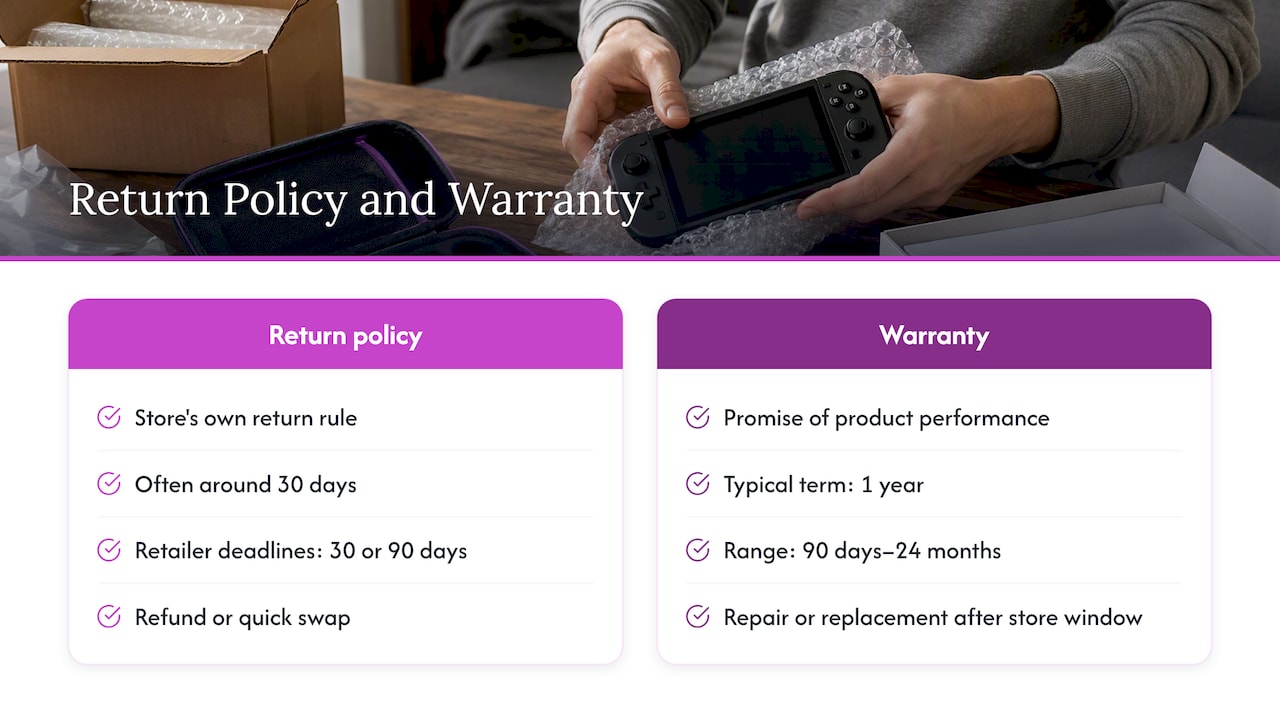
A return policy is the store’s own rule for taking a product back. It is usually short, often around 30 days, and mostly a courtesy. Consumer Action notes that many retailers set return or exchange deadlines at 30 or 90 days. Inside that window you can often get a refund or a quick swap with little paperwork.
A warranty is a promise about how the product will perform over a longer period. The same Consumer Action guide says a typical manufacturer’s warranty on devices lasts one year, though some run as short as 90 days or as long as 24 months. A warranty is where you go for a repair or replacement after the store window has closed.
A simple rule: if you are inside the return window and just want your money back, go to the seller. If the window has passed and the device has a defect, go to the warranty.
For our own customers, the two are laid out separately. Our console return policy guide explains the 30-day return window, and the refund policy page has the terms in full.
What US law says about handheld warranties
The rules are less strict than many people assume, and more protective than others fear.
Written warranties
Federal law does not force a company to offer a written warranty. If it does offer one, the Magnuson-Moss Warranty Act applies. The FTC’s consumer guidance explains that the act covers consumer products costing more than $15.00 and that the terms must be available for you to read before you buy.
The statute also sets a remedy. If a product still has a defect after a reasonable number of repair attempts, the consumer can choose a refund or replacement under the rules for full warranties. The text is in Title 15 of the US Code. Note that the remedy depends on the type of warranty the company gave, so read the written terms rather than assuming.
Implied warranties
Most states also recognize an unwritten implied warranty that a product will work as an ordinary product of its kind should. According to the FTC, implied warranties can last as long as four years in some states. That varies by state, and some sellers sell “as is” where state law allows it. If your written warranty has expired and the device failed early, a state consumer protection office or a lawyer can tell you whether an implied warranty applies where you live.
Opening the case or using third-party accessories
A common fear is that opening a device or using a non-brand part kills the warranty. The FTC says a company generally cannot void coverage just because you used third-party parts or services, unless it can show that the specific part caused the damage. Still, we would not take a handheld apart while it is covered. If you do, proving that the original defect, not your repair, caused the fault gets much harder. That is a practical point, not a legal one.
Before you contact anyone: build your file
A clean file turns a back-and-forth into a single email. Gather these first.
- Proof of purchase. An order confirmation email, receipt, invoice or credit card statement. The USAGov complaint guide lists sales receipts, warranties and emails with the company as the documents to collect.
- The serial number. Many companies will look up a claim by serial number or registration details if the receipt is gone, though that is at their discretion.
- The warranty terms. Read what is covered, the length, and how to submit a claim. Terms differ for each product.
- A short description of the fault. When it started, what you were doing, what you already tried.
- Photos or a short video. A video of the screen flickering, the buttons failing or the battery not charging is better than a paragraph describing it.
Can you claim without a receipt? Sometimes. Check your email for the order confirmation and your card or bank app for the charge. Those usually work as proof of purchase date.
Step by step: filing the claim
1. Troubleshoot first, and say what you tried
Support teams will ask. Charge the device with a different USB-C cable and wall adapter, try a different battery if yours is removable, and remove any added microSD card to see whether the fault follows the card. Mention each step in your message. It saves a round trip and shows the defect is real.
If your handheld runs hot, our guide to safe fixes for retro handheld overheating covers what to check before you blame the hardware.
2. Contact the right party quickly
Start with the seller if you are still in the return window. Go to the manufacturer if you are past it. In either case, write instead of calling only, so you have a record. Consumer Action’s advice is to report a defect as soon as you find it, because delay can invite suspicion of misuse or accidental damage.
3. State what you want
Name the remedy: repair, replacement or refund, whichever the terms allow. Include your order number, serial number, purchase date and your files. Keep the message short.
4. Follow the return instructions exactly
Companies often issue an authorization number or a prepaid label. Use what they give you. Sending a device without that step can leave you with no record that they received it.
5. Ship it with evidence
Before you send the device, photograph its condition, its serial number and the packaging. If the box arrives damaged or goes missing, those photos help you dispute shipping liability, as Consumer Action’s guidance points out. Keep the tracking number: it is your proof the company received the unit.
6. Follow up in writing
If you hear nothing in a week or so, reply on the same thread with the date you shipped and the tracking number. Keep a dated log of every contact.
What a typical claim file looks like
| Item | Why it matters | Where to find it |
|---|---|---|
| Order confirmation | Proves purchase date and buyer | Email inbox, order account |
| Card or bank statement | Backup proof of purchase | Card app, monthly statement |
| Serial number | Identifies the exact unit | Device label or settings screen |
| Fault video | Shows the defect without debate | Your phone |
| Troubleshooting notes | Shows normal use and attempted fixes | Your own log |
| Shipping photos and tracking | Protects you if the package is lost | Camera roll, carrier receipt |
Common reasons claims get denied, and the answer
“It was physical damage.” Warranties usually cover defects in materials and workmanship, not drops or liquid. Footage of the fault appearing with no impact helps. The burden often falls on you to show the defect was there from the start, so detail matters.
“The warranty has expired.” Check the exact purchase date and the stated term. Then consider whether an implied warranty applies in your state, and whether your credit card offers extended warranty or purchase protection, as Consumer Action suggests checking.
“You modified it.” Ask the company to state in writing which modification caused which damage. Under the FTC’s guidance, that connection is what a company must be able to show.
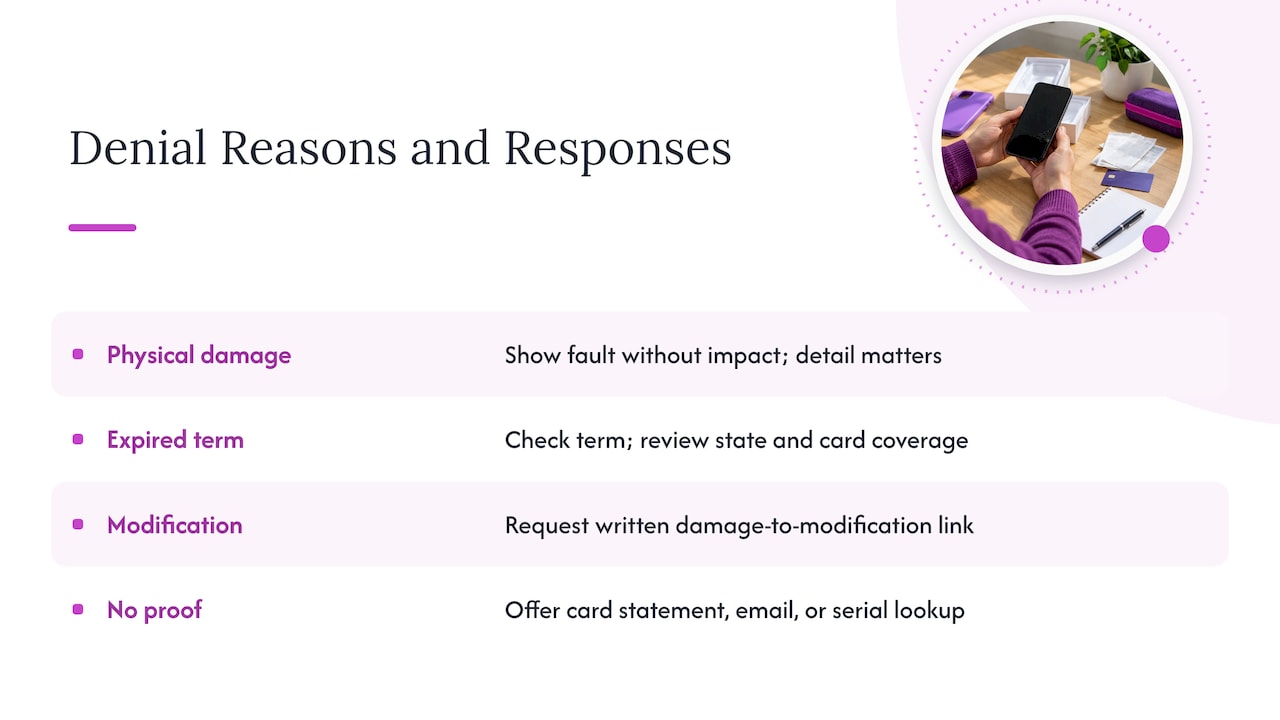
“No proof of purchase.” Offer card statements, an email confirmation or a serial number lookup. It is up to the company, but a polite, well-documented request often works.
If the company says no
- Ask for the denial and its reason in writing. A vague phone answer is hard to challenge.
- Contact your card issuer. A dispute or an extended warranty benefit can sometimes settle things faster than the manufacturer.
- Go back to the FTC’s guidance. Its page on solving problems with a business walks through contacting the company, then moving up.
- File a complaint. The USAGov complaint page points you to the right agency, and your state attorney general or consumer protection office handles disputes under state law.
- Talk to a lawyer if the amount is large or the claim involves an implied warranty in your state.
Perspective: what we have learned about handheld warranties
Most warranty trouble does not start with a broken device. It starts with a buyer who cannot tell what they were promised, or who waited three months to say something. When we built Retro Pulse around a U.S. warehouse, a one-year warranty and a 30-day return window, the aim was to make that conversation short: you know where the unit shipped from, you know the terms, and you know which clock is running.
Our view is that a warranty is only as good as how easy it is to use. That is why we push buyers to do three things on day one: save the order email, test every button, the screen, charging and the card slots in the first week, and speak up early if something is wrong. A fault found in week one is a return. A fault found in month nine is a warranty claim. Both are fine, but the first is faster.
We also think removable batteries matter here. Retro Pulse uses a removable battery with a 6 to 8 hour life, so a battery problem can often be isolated without sending the whole console away. It is not the answer to every fault, but it makes troubleshooting less of a guess.
If you are weighing a preloaded handheld, read our notes on the risks to check on preloaded consoles before you buy anything, from us or anyone else.
— Sean
Retro Pulse coverage at a glance
If you are shopping for a handheld and want coverage you can understand, here is what we publish for Retro Pulse:
- A one-year warranty.
- 30-day returns.
- Shipping from a U.S. warehouse.
- A removable battery and USB-C charging.
- Dual microSD slots for adding your own games.
Retro Pulse comes preloaded with 15,000 classic games from over 20 systems, with a 3.5" IPS display and real D-pad, twin sticks and L/R triggers. You can see the console and current checkout details on the Retro Pulse product page. Read the warranty and refund terms on our site before you order, as you should with any device.

Habits that make a future claim easier
- Save the paperwork the day it arrives. Forward the order email to a folder, or take a photo of the receipt.
- Write down the serial number and keep it with the order number.
- Keep the box for the first few weeks. It makes a return simpler.
- Test everything early. Buttons, sticks, triggers, screen, speakers, charging, card slots.
- Use the right accessories. A quality USB-C charger and reputable microSD cards help avoid faults that are blamed on the device.
- Do not open the casing while the warranty runs, even if the law protects you from a blanket void.
If you are still comparing options, our guide to retro handheld comparison for parents covers what to look for beyond the spec sheet.
FAQ
What are the warranty laws in the USA?
Federal law does not require a written warranty, but when a company gives one on a consumer product costing over $15.00, the Magnuson-Moss Warranty Act sets disclosure rules. Most states also have implied warranties, which in some states last up to four years. The details depend on your state and on the exact terms the company wrote.
How do I claim a warranty on a handheld?
Gather your proof of purchase and serial number, then contact the seller or manufacturer in writing with a clear description and a photo or video of the fault. Follow their return instructions, photograph the device before shipping and keep the tracking number. Do this as soon as you find the problem.
Can I claim my warranty without a receipt?
Often you can, but it depends on the company. An order confirmation email, a card statement or a serial number lookup can stand in for a receipt. Offering more than one form of proof raises your chances.
Does opening my handheld void the warranty?
The FTC says a company generally cannot void a warranty only because you used third-party parts or services, unless it shows they caused the damage. In practice, a DIY repair makes it harder to prove the original fault was a defect. It is safer to leave the case closed while you are covered.
Sources
- Warranties, FTC Consumer Advice
- Device Warranties 2024, Consumer Action
- U.S. Code Title 15, Chapter 50, Consumer Product Warranties
- Solving Problems With a Business: Returns, Refunds, and Other Resolutions, FTC
- How to file a complaint about a company’s products or services, USAGov