There is no federal law that gives you the right to return a console just because you changed your mind. In the United States, the seller’s own policy decides: how many days you get, who pays shipping, whether opening the box costs you a fee. This guide explains how those policies work, which details trip people up, and how to protect yourself on any console purchase, including ours.
TL;DR
- No federal rule forces a retailer to accept a non-defective console back. The FTC says the seller must tell you its refund terms, and you are held to what was posted at purchase.
- Windows, restocking fees and packaging rules differ by seller, so read them before you pay, not after the box is open.
- A warranty and a return policy are different things. A warranty covers defects. A return policy lets you change your mind.
- Keep the receipt, the box and every email until the window closes.
- Retro Pulse ships from a U.S. warehouse with a 30-day return window and a one-year warranty.
Table of Contents
- What the law says (and doesn’t) about returning a console
- Return window vs. warranty: two different promises
- The fine print that decides whether you get your money back
- A short checklist before you buy any console
- Gifts and returns: the timing trap
- How to make a return go smoothly
- Why preloaded handhelds raise extra questions
- Our perspective: a return policy tells you how a seller thinks
- Retro Pulse: what you get and how returns work
- Common return-policy mistakes to avoid
- FAQ
- Sources
What the law says (and doesn’t) about returning a console
Many buyers assume the law protects them with a cooling-off period. For most store and online console purchases, it does not. The FTC’s online shopping guidance tells you to check the seller’s refund policy before buying: whether you can return the item for a full refund, who pays return shipping, and how many days you have.
That guidance points to the real rule: a company has to disclose its terms before the sale. If it says 30 days, you get 30 days. If it says store credit only, that is what you get, as long as it was clear up front.
A few things the law does cover:
- Shipping promises. Under the FTC’s Mail, Internet, or Telephone Order Merchandise Rule, sellers must ship within the time they advertise, and must have a reasonable basis for that promise. If the order is late, you generally have the right to cancel and get your money back.
- Refund timing. According to the FTC, when a seller accepts a return and you qualify for a refund, for most payment types it must refund you within 7 business days of accepting the item.
- Defective products. If a console arrives broken, you are in a different situation. That is a warranty and product-quality issue, not a change-of-mind return.
State laws and card-network rules can add protections in some cases, but they vary, so check your state attorney general’s consumer page or your card issuer if a seller refuses a refund you believe you are owed.
Return window vs. warranty: two different promises
This is the mix-up that costs people the most. The FTC’s warranty guidance describes a warranty as a promise about the product, and the usual remedy is repair or replacement, not a refund. A return policy is a commercial service: the seller agrees to take the item back for a set period.
| Return policy | Warranty | |
|---|---|---|
| What it covers | Any reason, including “I don’t like it” | Defects in materials or workmanship |
| Typical length | Days to a couple of months | Often a year or more |
| Usual remedy | Refund, exchange or store credit | Repair or replacement |
| Who sets it | The seller | The manufacturer or seller |
| Condition rules | Often original packaging, sometimes unopened | Proof of purchase, no misuse |
When the return window closes, the warranty is usually your fallback. The FTC advises you to start with the seller, then write to the manufacturer if the seller doesn’t resolve it.
The fine print that decides whether you get your money back
Policies for consoles tend to be stricter than policies for a shirt. The product is expensive, easy to resell only if it is complete, and costly to inspect. Look for these five details.
1. The clock start
Some sellers count from the day you order, some from the ship date, some from delivery. A few days of difference matters when a gift sits in a closet. Check which one applies, and write the date down.
2. Opened versus unopened
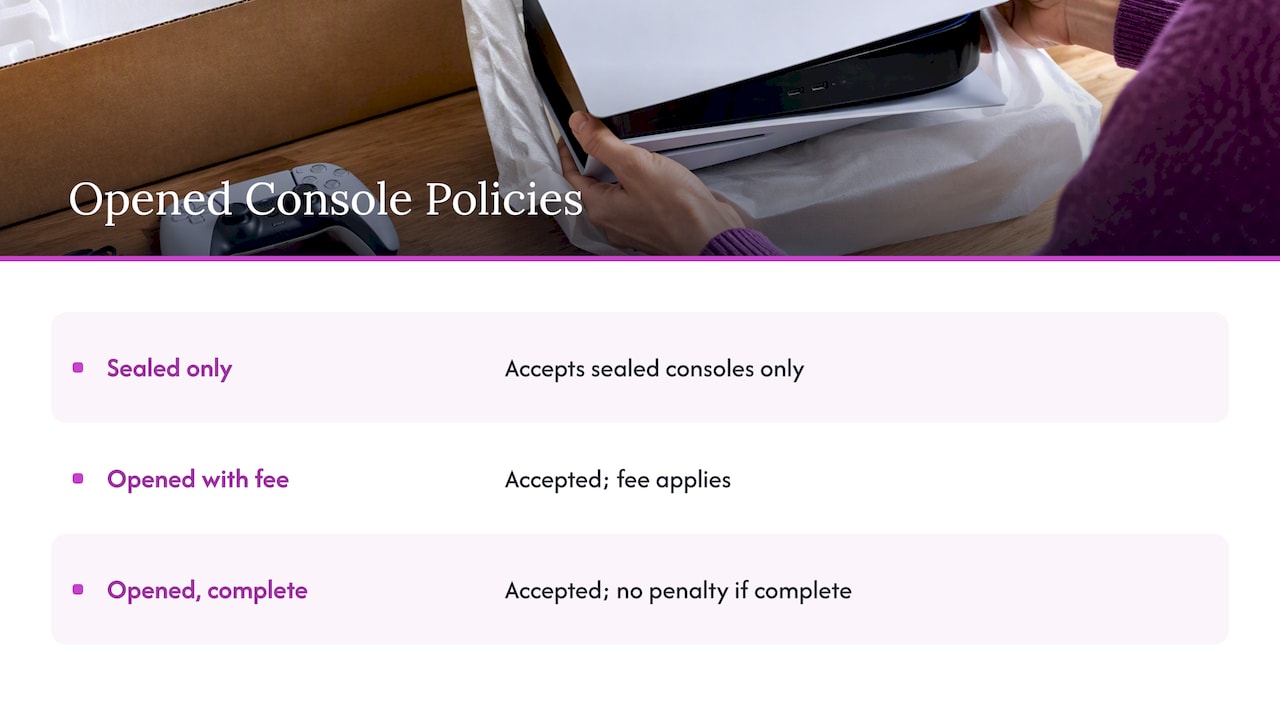
Some retailers accept only sealed consoles, some accept opened ones with a fee, and some accept them with no penalty if the item is complete. “Can I return it if I opened it?” is the most common console question, and the answer is always in that specific seller’s policy. It is not a universal rule.
3. Restocking and shipping fees
Some big chains charge a percentage restocking fee on opened electronics, and some charge a flat fee for console returns. The amounts differ by seller and sometimes by state. Ask three questions before checkout: is there a fee, how much, and does it apply to online orders?
4. Refund method
The FTC notes that sellers often prefer store credit over refunds to the original payment. Confirm whether you get money back to your card or a credit you can only spend with that seller.
5. Packaging and completeness
Missing cables, a crushed box or absent paperwork can reduce a refund or void it. Keep everything. Retailers also track return history, and frequent returns or returns missing original packaging can trigger a block on future returns, even inside the stated window. Hold on to the box and inserts until the window closes for good.
A short checklist before you buy any console
- Find the return policy page and screenshot it. If the terms change later, you have proof of what applied when you paid.
- Note the window and when it starts.
- Check who pays return shipping. On a heavy box, this can be real money.
- Look for fees on opened items.
- Check the warranty length and how to claim. An email address is better than nothing; a clear process is better still.
- Check where it ships from. Long overseas transit eats into your return window, and sending a return back across an ocean is a headache. A U.S. warehouse makes returns simpler.
- Pay with a card, not a transfer. Cards give you a dispute option if a seller doesn’t honor its terms.
Gifts and returns: the timing trap
Consoles are a popular gift, and holiday gifts are where windows go wrong. You buy in early November, wrap it, and the recipient opens it in late December. By then, a 30-day window may have expired.
If you’re buying a gift:
- Count the days from delivery to the day it will be opened.
- Ask whether a gift receipt or order number is enough, or whether the original card is required.
- Tell the recipient to keep the box.
- Test the device yourself if the policy allows it, or confirm the warranty covers it from the purchase date.
Some sellers extend windows around the holidays. Many do not. Never assume.
How to make a return go smoothly
The FTC says to gather your documents and learn the company’s return policy before you go back to the store or website. In practice:
- Start inside the window. Don’t wait for the last day.
- Contact the seller in writing. Email or chat leaves a record. A phone call alone does not.
- Pack it as it came. Console, cables, inserts, original box.
- Use tracked shipping and keep the tracking number.
- Photograph the contents before sealing the box.
- Follow up. If you haven’t seen your refund after the seller received the box, write again and cite the date it was delivered.
- Escalate if needed. If you can’t get help from the seller, the FTC suggests contacting a consumer protection agency or your card issuer and reporting the problem.
Why preloaded handhelds raise extra questions
A branded console from a big manufacturer comes with a recognizable policy. A preloaded retro handheld often comes from a small seller, sometimes shipping from overseas, sometimes with no clear policy at all. Before buying one, ask:
- Is there a real U.S. address or warehouse for returns?
- Does the seller state both a return window and a warranty?
- Is there a contact that answers?
We wrote separately about what to check on preloaded consoles, including three risks worth knowing before you order anything in this category.
Our perspective: a return policy tells you how a seller thinks
We sell one product, the Retro Pulse, so we have thought a lot about what a buyer needs to feel safe ordering a handheld online from a brand they haven’t heard of. Here is our view.
A return policy is a promise about confidence. A seller that hides its terms, or buries them behind a long chain of conditions, is telling you something about the product. We would rather you read ours before you buy.
The second point is shipping. Many cheap handhelds come from suppliers overseas, and buyers wait weeks for them. When the unit then has a problem, the return window may already be half gone. That is why we ship from a U.S. warehouse, and why we tested and reviewed the device before listing it. A short trip to your door means your 30 days are spent playing, not waiting.
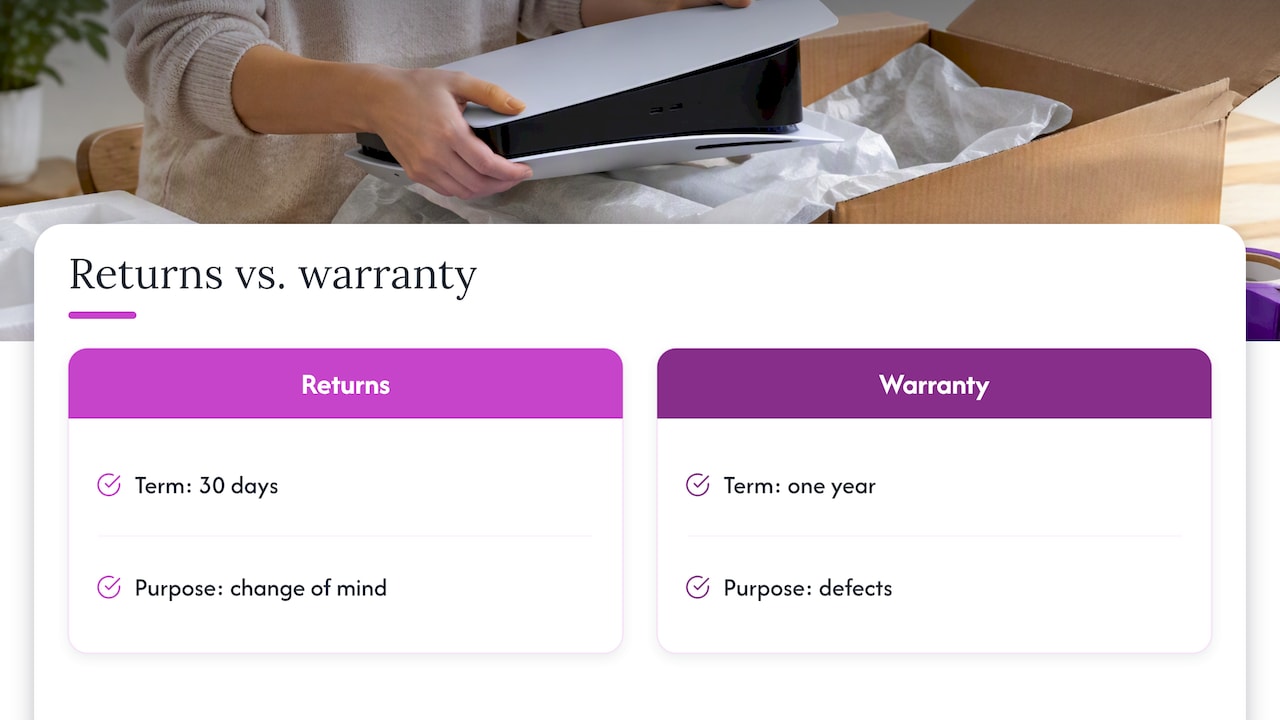
Third, we think warranty and returns should be kept separate and stated plainly. Ours are: 30-day returns if the device isn’t for you, and a one-year warranty if something goes wrong with it. One covers a change of mind, the other covers defects.
Finally, a console should be ready to play. Retro Pulse arrives with 15,000 classic games from more than 20 systems already loaded, with no downloads, subscriptions or menu setup. If you want to know whether a handheld like this fits you better than a mainstream console, we compared them in Switch or retro handheld.
— Sean
Retro Pulse: what you get and how returns work
If you are shopping for a retro handheld and want terms you can read before you pay, here is how the Retro Pulse stacks up.
- Library: 15,000 games across more than 20 systems, including NES, SNES, Genesis, PS1, N64, Game Boy, GBA and Arcade.
- Screen and controls: a 3.5" IPS display, a real D-pad, twin sticks and L/R triggers.
- Power: removable battery rated for 6 to 8 hours, USB-C charging.
- Storage: dual microSD slots if you want to add games.
- Shipping: from a U.S. warehouse.
- Protection: a one-year warranty and 30-day returns. The full wording is on our refund policy page.
You can see the console and its current details on the Retro Pulse product page.

Common return-policy mistakes to avoid
- Throwing away the box the day it arrives. It’s often the first thing a return department asks about.
- Assuming the warranty means a refund. It usually means repair or replacement.
- Missing the clock. The window may have begun at shipment, not when you opened the package.
- Relying on a verbal promise. If a support rep says an exception applies, get it in writing.
- Buying from a seller with no U.S. return address. Returning across borders can cost more than the item is worth.
- Deleting emails. The FTC says records of your communication with the seller are what you need if you have to prove your case.
FAQ
Can I return a console if I opened it?
It depends entirely on the seller. Some accept opened consoles within the window, some add a restocking fee, and some take back only sealed units. Read the policy for that retailer before you open the box, and keep every piece of packaging either way.
Is there a federal law that guarantees console returns in the US?
No. The FTC advises you to check a seller’s refund terms before buying because the seller must state them, but nothing requires a retailer to take back a working item. A defective console falls under warranty and product-quality rules instead.
How long does a refund take after I return a console?
The FTC says that for most payment types, a seller must refund you within 7 business days of accepting your return. Your card issuer may take additional days to post the credit.
What if my return window has closed and the console is faulty?
Use the warranty. Contact the seller first, then the manufacturer if needed, and have your proof of purchase ready. With Retro Pulse, our one-year warranty covers defects, and you can start a claim by reviewing our policy page.
What is the return window on the Retro Pulse?
Retro Pulse comes with 30-day returns and a one-year warranty, and it ships from a U.S. warehouse. The full terms are on our refund policy page, so read them before you order.
Sources
- FTC: Online Shopping
- FTC: Solving Problems With a Business: Returns, Refunds, and Other Resolutions
- FTC: Warranties
- FTC: What to do if your online order never arrives
- FTC: Have a problem with something you bought?
- eCFR: 16 CFR Part 435, Mail, Internet, or Telephone Order Merchandise