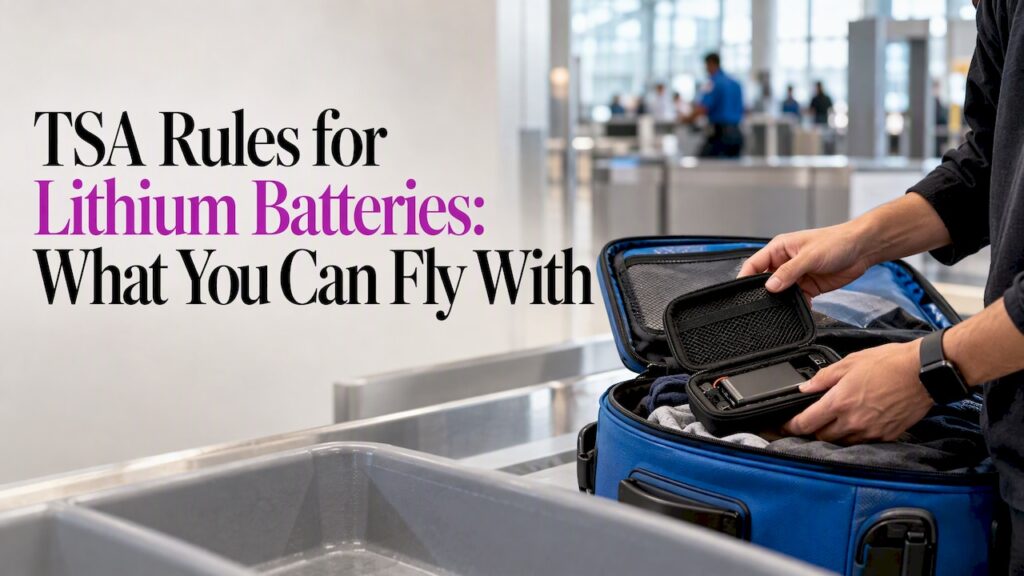
The short version: spare lithium batteries and power banks go in your carry-on, never your checked bag. Most consumer batteries are fine if they are 100 watt-hours (Wh) or less. Devices with lithium batteries inside, like phones, laptops and handheld consoles, can usually ride in either bag, though carry-on is the smart place for them. The details below cover the limits, the math, the exceptions, and what to do at the gate.
TL;DR
- Spare lithium batteries and power banks must travel in the cabin. The FAA says they cannot be checked.
- Rechargeable batteries up to 100 Wh are allowed on passenger aircraft. 101 to 160 Wh needs airline approval, and anything over 160 Wh is not allowed.
- Watt-hours = volts × amp-hours. For mAh, divide by 1,000 first. A 20,000 mAh power bank at 3.7 V is 74 Wh.
- If your carry-on is gate-checked, take every spare battery and power bank out and keep them with you.
- Plain AA and AAA alkaline batteries are a different category and are fine in both carry-on and checked bags.
Table of Contents
- The core rule: carry-on yes, checked bag no
- TSA lithium battery limits by size
- How to calculate watt-hours from mAh
- Power banks: the details that trip people up
- What to do if your carry-on gets gate-checked
- Damaged, defective or recalled batteries
- Can you bring AAA batteries on a plane?
- Packing loose batteries safely
- Perspective: what we tell people who fly with a handheld
- Making a handheld’s battery last through a trip
- Looking for a handheld that suits a travel bag?
- A pre-flight battery checklist
- FAQ
- Sources
The core rule: carry-on yes, checked bag no
There are two kinds of lithium battery in your luggage, and the rules treat them differently.
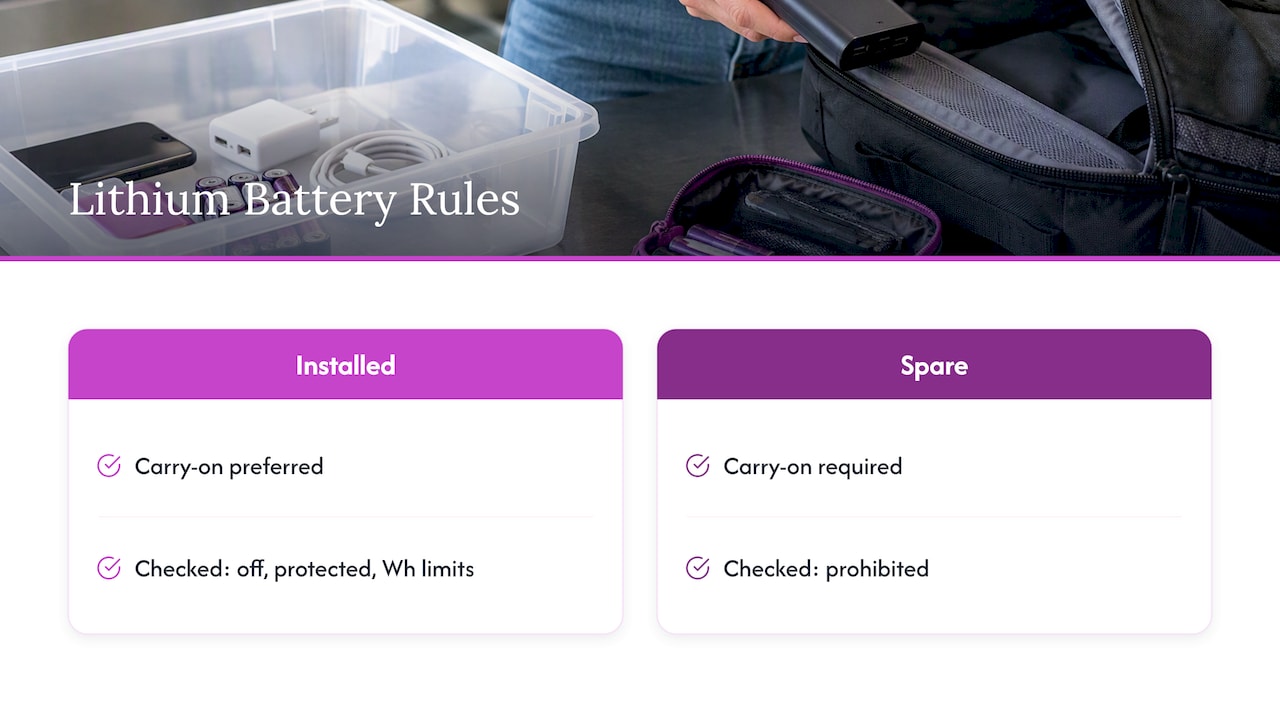
Installed batteries live inside a device: your phone, laptop, camera, e-reader or handheld game console. Spare batteries are loose: a swappable camera battery, a second console battery, or a power bank.
For spares, the FAA is blunt. Spare lithium batteries and power banks must be carried on and cannot be checked. The reason is practical. A lithium battery that overheats in the cargo hold has no one next to it to notice, smell smoke, or reach for it. In the cabin, a crew member can respond.
For devices with installed batteries, the FAA allows checking them only if they are completely powered off and protected from accidental activation, and only within the watt-hour limits. TSA also says that devices containing lithium batteries should be carried in carry-on baggage. Treat “allowed in checked” as a technicality and carry your electronics with you. A bumped, crushed or switched-on device in a suitcase is the exact scenario the rules exist to prevent, and a checked bag is also where a device is most likely to be damaged or stolen.
Who actually makes the rules
TSA screens you and your bags. The underlying hazardous-materials rules come from the FAA, and airlines can add stricter policies on top. When two of them disagree, follow the strictest. Delta, for example, asks that power banks be kept in an accessible spot in the carry-on rather than an overhead bin, and caps passengers at two power banks of 100 Wh or less each. Check your own airline’s page before you fly, because these policies change.
TSA lithium battery limits by size
Everything comes down to watt-hours, a measure of how much energy the battery holds. Here are the bands that apply to lithium-ion batteries, the rechargeable type in nearly every consumer gadget.
| Battery capacity | Allowed on passenger aircraft? | Notes |
|---|---|---|
| 0 to 100 Wh | Yes | Rechargeable batteries in this range are allowed. Spares go in carry-on only. |
| 101 to 160 Wh | Only with airline approval | Up to two spare lithium-ion batteries in this range |
| Over 160 Wh | No | Forbidden on passenger aircraft |
The 100 Wh line covers almost everything most travelers own: phones, tablets, most laptops, cameras, e-readers, wireless earbuds, handheld consoles, and the majority of power banks. The 101 to 160 Wh band is where large camera batteries, some professional equipment and a few oversized power banks live.
Lithium metal batteries use grams, not watt-hours
Non-rechargeable lithium metal batteries, like the coin cells in key fobs and some cameras, are measured by lithium content instead. TSA lists a limit of 2 grams of lithium per battery for the ordinary allowance. With airline approval, you may carry up to two spare lithium metal batteries in the 2 to 8 gram range. Most travelers never touch this limit.
How to calculate watt-hours from mAh
Many batteries only print milliamp-hours (mAh) on the label, not watt-hours. The FAA’s method is simple: multiply volts by amp-hours, and for milliamp-hours divide by 1,000 first.
Formula: Wh = (mAh ÷ 1,000) × volts
Most lithium-ion cells are rated at about 3.7 V, and the voltage is printed on the battery or device. Here are some worked examples using that common voltage:
| Battery | Math | Result | Under 100 Wh? |
|---|---|---|---|
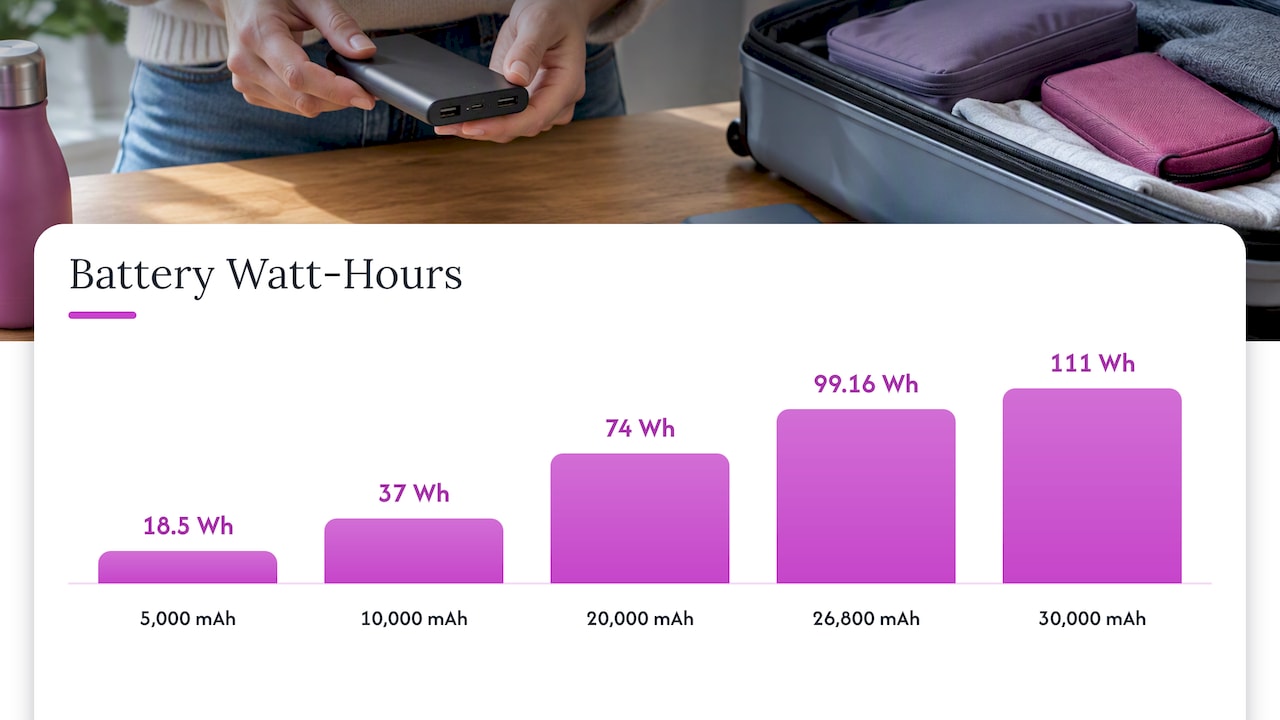
| 5,000 mAh at 3.7 V | 5 × 3.7 | 18.5 Wh | Yes |
| 10,000 mAh at 3.7 V | 10 × 3.7 | 37 Wh | Yes |
| 20,000 mAh at 3.7 V | 20 × 3.7 | 74 Wh | Yes |
| 26,800 mAh at 3.7 V | 26.8 × 3.7 | 99.16 Wh | Yes, barely |
| 30,000 mAh at 3.7 V | 30 × 3.7 | 111 Wh | No, needs airline approval |
So the common question, is a 20,000 mAh power bank allowed on a plane, has a clear answer: yes, in your carry-on. TSA’s power bank page says power banks may be carried in carry-on bags but not in checked bags.
Two cautions. First, some power banks print a rating at a different voltage, such as 5 V, which is the output voltage and not the cell voltage. If the label already shows Wh, use that number and skip the math. Second, if a label is missing, worn or unreadable, a security officer cannot verify it, and you may lose the battery at the checkpoint. Buy batteries with clear markings.
Power banks: the details that trip people up
Power banks cause more confiscations and confusion than any other battery item, so here is how to stay clear of trouble.
- Carry-on only. No exceptions for checked bags.
- Know the Wh number. Be able to point to it on the label.
- Keep it reachable. Airlines increasingly want power banks where you can see and get to them, not buried in an overhead bin. Delta’s policy, linked above, spells this out.
- Watch the in-flight use rules. Delta says power banks must not be recharged or used to charge devices during taxi, takeoff or landing. Other airlines have their own limits, and some are stricter.
- Cap the count. Delta limits passengers to two power banks. Even if TSA does not give a hard number for your 100 Wh-or-less spares, an airline may.
If a power bank gets hot, swells, smells odd or smokes, tell a flight attendant immediately. Do not try to deal with it yourself.
What to do if your carry-on gets gate-checked
This happens on full flights, especially with small regional jets and boarding group 8. The bag goes into the hold at the jet bridge or on the tarmac, and any spare batteries inside suddenly become a problem.
The rule is straightforward: when a carry-on is checked at the gate or planeside, all spare lithium batteries and power banks must be removed and kept with you in the cabin. A practical routine:
- Keep spare batteries and power banks in a small pouch inside your personal item, not buried in the roller bag.
- When the gate agent tags your bag, pull the pouch out before you hand it over.
- Turn off any devices staying inside the bag completely, rather than leaving them asleep.
If your device has a battery you cannot remove, such as a phone, it can stay in the bag only if it is powered off and protected. In practice, just carry it.
Damaged, defective or recalled batteries
A battery that has been recalled, swollen, dented or cracked is not just “less safe”: it is generally not allowed on the plane. The FAA states that damaged or recalled batteries and battery-powered devices must not be carried aboard unless the battery has been removed or otherwise made safe.
Before a trip, take two minutes to check every battery and device you plan to carry:
- Look for bulging, warping or a case that no longer closes flat.
- Check for scorch marks, leaking residue or an unusual smell.
- Search the model name along with “recall” if it is a cheap or unbranded power bank.
If anything looks wrong, leave it home and recycle it properly at a battery drop-off location. A swollen battery is also a sign it is overdue for replacement, whatever device it powers.
Can you bring AAA batteries on a plane?
Yes. The question comes up because “battery” sounds like “lithium battery,” but ordinary AA, AAA, C, D and 9-volt alkaline cells are a separate category. TSA lists dry batteries in both carry-on and checked bags, noting they should be protected from damage and from creating sparks or dangerous heat.
So three AAA batteries, or a pack of twelve, are fine. Keep them in their original packaging or a case so the terminals cannot touch each other or loose metal like keys and coins. Note that lithium AAA batteries, the non-rechargeable type sold for cold-weather gear and some cameras, are lithium metal batteries and follow the lithium rules.
Packing loose batteries safely
The main hazard with spares is a short circuit: metal touching both terminals. The FAA’s lithium guidance asks passengers to protect spare batteries from this. Easy ways to do it:
- Leave batteries in their retail packaging.
- Put each in its own plastic bag or a dedicated battery case.
- Cover exposed terminals with tape.
- Keep them away from coins, keys and tools in the same pocket.
This matters for any device with a swappable battery, including cameras, drones, vape-free e-readers and handheld game consoles that use a removable pack.
Perspective: what we tell people who fly with a handheld
We build the Retro Pulse as a travel-friendly console, so airport questions land in our inbox regularly. Here is how we think about it.
The Retro Pulse uses a removable battery, with a rated 6 to 8 hours of play, and charges over USB-C. Removable is great for long trips because you can swap a charged pack in mid-journey. It also means the battery is, in airline terms, both an installed battery and, if you own a second one, a spare. That second pack is where the rules bite: it goes in your carry-on, protected from shorting, never in a checked suitcase.
We do not publish a watt-hour figure here, so look at the label on your own battery and run the math above. Handheld batteries of this type are typically far below the 100 Wh line, but do not take our word or anyone else’s for it when a label can answer in five seconds.
Our practical advice:
- Power the console fully off before security and boarding, not just sleep mode. Many people assume sleep is off and it is not.
- Carry it, don’t check it. A console in your personal item is safe from bag-handling damage and meets the airline’s guidance to keep devices in the cabin.
- Follow cabin crew instructions at takeoff and landing. Airlines can ask for devices to be stowed.
- Treat heat as a warning. If a battery gets unusually hot, stop using it. Our guide to safe fixes for handheld overheating explains what is normal and what is not.
- Don’t charge on a cheap, unknown power bank if you can avoid it. Use a name-brand one with a clear Wh label.
The nice thing about an offline-first handheld is that there is no Wi-Fi to find and no airplane-mode juggling. You power it on, pick a game, and play. We cover that side in offline travel games for kids, a good read if you are packing for a family trip.
— Sean
Making a handheld’s battery last through a trip
The best way to avoid carrying extra batteries is to get more from the one you have. A few habits stretch a charge across a long travel day:
- Lower screen brightness once the cabin lights dim.
- Use headphones at a moderate volume rather than the speaker.
- Start the trip fully charged, and top up at the gate before boarding.
- Close any feature you are not using.
We go through the full list in 12 fixes to improve handheld battery life. If you still want a swap, one properly packed spare is easy to carry and well within normal airline practice.
Looking for a handheld that suits a travel bag?
The Retro Pulse is a handheld preloaded with 15,000 classic games across more than 20 systems, including NES, SNES, Genesis, PS1, N64, Game Boy, GBA and arcade. It has a 3.5-inch IPS display, a removable battery, USB-C charging and dual microSD slots for adding your own games. It ships from a U.S. warehouse, comes with a one-year warranty, and has 30-day returns. It plays offline, so a flight, a train or a back seat is all the setup it needs. If you want to understand how coverage works, see our page on the handheld console warranty.
A pre-flight battery checklist
Run through this the night before you fly:
- Gather every battery, power bank and charger into one bag.
- Read the Wh label on each spare. Do the math for any that show only mAh.
- Confirm nothing is damaged, swollen or under recall.
- Protect terminals with cases, bags or tape.
- Put spares and power banks in the carry-on, within reach.
- Charge your devices, then plan to power them fully off for any time they sit in a bag.
- Check your airline’s battery page for limits on count and in-flight use.
- If you need a 101 to 160 Wh battery, contact the airline well before the trip for approval.
TSA’s final call always rests with the officer at the checkpoint, so when something is borderline, a clear label and a tidy pack help. If you are unsure about a specific item, TSA’s What Can I Bring tool lets you look it up, and you can also contact AskTSA.
FAQ
Can lithium batteries go in checked luggage?
Spare lithium batteries and power banks cannot. They must be in your carry-on. Devices with installed batteries may be checked only if fully powered off and protected from accidental activation, but carrying them in the cabin is the safer choice.
What is the TSA lithium battery limit?
Lithium-ion batteries up to 100 Wh are allowed without special approval. Between 101 and 160 Wh you may carry up to two spares with airline approval. Above 160 Wh, batteries are not allowed on passenger aircraft.
Is a 20,000 mAh power bank allowed on a plane?
Yes, in your carry-on. At about 3.7 V it works out to roughly 74 Wh, under the 100 Wh line. Check the label for the actual figure, and check your airline’s count and in-flight use rules.
Can I bring 3 AAA batteries on a plane?
Yes. Regular alkaline AAA batteries are allowed in both carry-on and checked bags. Keep them in packaging or a case so the ends cannot touch metal. Lithium AAA batteries fall under the lithium rules.
What if my carry-on is gate-checked and has a power bank in it?
Take the power bank and any spare batteries out before handing the bag over, and keep them with you in the cabin. The FAA requires this for all spare lithium batteries.
Sources
- Airline Passengers and Batteries, FAA PackSafe
- PackSafe: Lithium Batteries, FAA
- Lithium batteries with more than 100 watt hours, TSA
- Power Banks, TSA
- Dry batteries (AA, AAA, C, and D), TSA
- What Can I Bring?, TSA
- Battery or Fuel-Powered Items, Delta Air Lines