The best retro games for beginners are the ones you can learn in a minute and enjoy in five: Kirby’s Dream Land, Super Mario Bros., Tetris, Pac-Man, Super Mario World, and The Legend of Zelda: A Link to the Past. They have readable graphics, fair controls and clear goals, so you do not need a manual or a guide to have fun. Below you will find 12 easy classics sorted by what kind of player you are, what makes an old game approachable, and the simplest ways to start playing.
TL;DR
- Start with short, forgiving games: Kirby’s Dream Land, Tetris, Pac-Man and Super Mario Bros. are easy to pick up and need no setup knowledge.
- Skip the earliest arcade-era and early 3D titles at first. Look for readable visuals, responsive controls and fair checkpoints instead.
- Games with a save feature, like Kirby’s Adventure and A Link to the Past, are far kinder to new players than games that make you restart.
- You can start through official classics subscriptions, low-cost digital stores, or a preloaded handheld that skips menus and downloads.
- Parents can share these games with kids: bright, short levels work for every age.
Table of Contents
- What makes a classic game easy to start with
- 12 easy classic games to start with
- Quick comparison: which first game fits you
- Which game for which kind of beginner
- How to start playing without a headache
- What to expect from the controls
- Where the Retro Pulse fits
- Get started with the Retro Pulse
- A simple first-week plan
- FAQ
- Sources
What makes a classic game easy to start with
An old game is beginner-friendly when it respects your time. One reviewer’s checklist for what holds up today is readable visuals, responsive controls, fair checkpoints and a solid modern port. If you can learn the basics in minutes and reach a flow state quickly, the game holds up.
That also explains why some famous classics are a poor first step. Games from before the 1983 crash can feel a little dry to newcomers, because they are built around competition through repetition and lack the sense of progress modern games provide. Early 3D titles can be rough too, with technical missteps and awkward cameras.
So use four quick filters when you pick a first game:
- Can you tell what to do in 30 seconds? One button to jump, one to act, one goal.
- Is failure cheap? Short levels, lives that refill, or a save feature.
- Do the graphics read clearly? Bright sprites and clean backgrounds make hazards obvious.
- Does it end a session gracefully? You should be able to play for five minutes or an hour.
12 easy classic games to start with
The list below mixes platformers, puzzle games, an arcade icon, an adventure and a racer. Years and platforms are the original releases. Where a claim comes from a review or list, it is linked.
The gentlest on-ramps
1. Kirby’s Dream Land (Game Boy, 1992). One list ranks it the easiest retro game to get into, calling it ridiculously easy, with a bright tone that charms new players. If you have never touched a retro game, this is the safest first hour.
2. Kirby’s Adventure (NES, 1993). It is far more accessible than most NES games thanks to a save feature that removes the need for passwords and eases the difficulty considerably. It also shows how much the NES could do with color.
3. DuckTales (NES, 1989). A reviewer describes it as a fun experience without too much challenge for people just getting into the NES library. You pogo on enemies, pick your level order, and explore.
4. Super Mario Bros. (NES, 1985). The template for every platformer. A 2026 NES roundup says it is easy to pick up and play. Run right, jump, stomp, repeat. Do not worry about finishing it, just enjoy world 1.
Short sessions and arcade fun
5. Tetris (Game Boy, NES, 1989 and after). Simple rules and an endless skill ceiling make it work for five-minute breaks and long sessions alike. A small tip from the same NES roundup: the NES version has 20 rows against the Game Boy’s 18, which makes it slightly easier.
6. Pac-Man and Ms. Pac-Man (arcade, 1980 and 1982). Pac-Man was originally released in English as Puck Man before being renamed. One writer says it is easy to enjoy today because it is more dynamic and harder to predict than you might expect, and calls Ms. Pac-Man a great jumping point into early gaming. Its appeal runs across generations: the publisher says it connects people across ages, borders and genders.
Bigger adventures that still welcome newcomers
7. Super Mario World (SNES, 1990). Bright visuals, short clever levels and real family friendliness put it among the top nostalgic games you can play today. If you pick only one game to share with a child, this is a strong choice.
8. The Legend of Zelda: A Link to the Past (SNES, 1991). One critic calls it the most timeless Zelda for newcomers, with colorful graphics, joyful controls and one of the best soundtracks of its era. It is longer than the others, so treat it as your second or third game.
9. Banjo-Kazooie (N64, 1998). Early 3D can be hard to get into, but this one is a perfect starting point for older 3D platformers with bright visuals and creative levels. Its simplified, refined controls avoid many camera and control headaches of the era.
More beginner-friendly picks
A fan-written starter list adds Super Mario Kart (1992), Donkey Kong Country (1994), Mega Man 2 (1988), EarthBound (1994) and Mike Tyson’s Punch-Out!! (1987) to the pile. Here is how I would use them:
10. Super Mario Kart (SNES, 1992). Easy to understand, great with a second player. For more racers across eras, see our retro racing games guide.
11. Donkey Kong Country (SNES, 1994). Gorgeous for its time and forgiving enough once you learn the barrel rhythm.
12. Mega Man 2 (NES, 1988). Pick your stage order and learn each boss weakness. It is harder than the rest, so save it for when you want a mild challenge.
If you enjoy head-to-head play, our list of retro fighting games is a good next step.
Quick comparison: which first game fits you
| Game | System | Best for | Session length | Difficulty feel |
|---|---|---|---|---|
| Kirby’s Dream Land | Game Boy | Total beginners | 20 to 30 minutes | Very gentle |
| Kirby’s Adventure | NES | Beginners who like exploring | 30+ minutes, with saves | Gentle |
| Tetris | Game Boy / NES | Commutes and breaks | 5 minutes and up | Easy to learn |
| Pac-Man | Arcade | Quick rounds, all ages | 5 to 10 minutes | Moderate |
| Super Mario Bros. | NES | The classic first step | 15 to 30 minutes | Fair |
| Super Mario World | SNES | Families | 30+ minutes | Fair |
| A Link to the Past | SNES | Adventure fans | Long, in chunks | Moderate |
| Banjo-Kazooie | N64 | Curious about early 3D | 30+ minutes | Gentle |
The session lengths and difficulty notes are my own rough guide for first-time players, not measured figures.
Which game for which kind of beginner
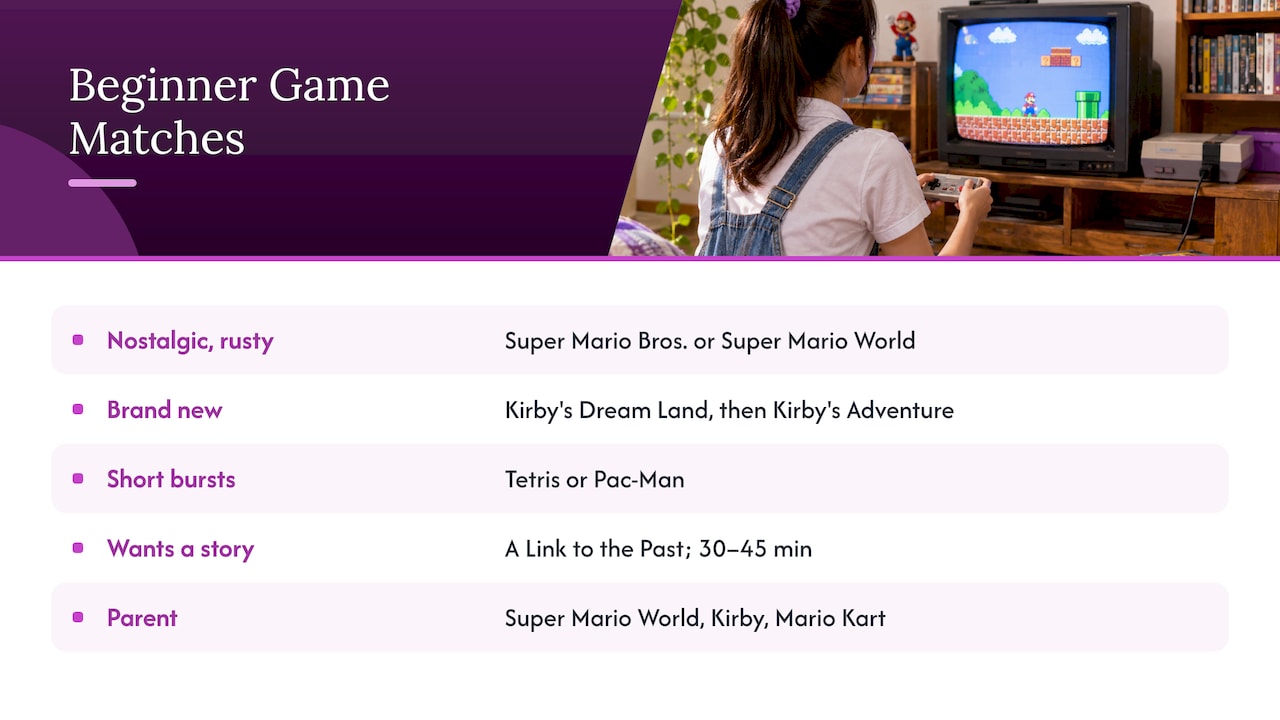
You are nostalgic but rusty. Start with Super Mario Bros. or Super Mario World. Your hands will remember more than you expect, and the first few levels teach everything again.
You are brand new. Begin with Kirby’s Dream Land, then Kirby’s Adventure. They build confidence before the harder games arrive.
You play on a commute or in short bursts. Tetris and Pac-Man are made for this. Pick up, play a round, put down.
You want a story. A Link to the Past is the long-form pick. Plan to play it in chunks of 30 to 45 minutes.
You are a parent. Super Mario World, Kirby and Mario Kart are bright, readable and easy to hand over. Our guide on how to share retro games with kids covers letting them lead, and the grandparent setup guide works the same way for older relatives.
How to start playing without a headache
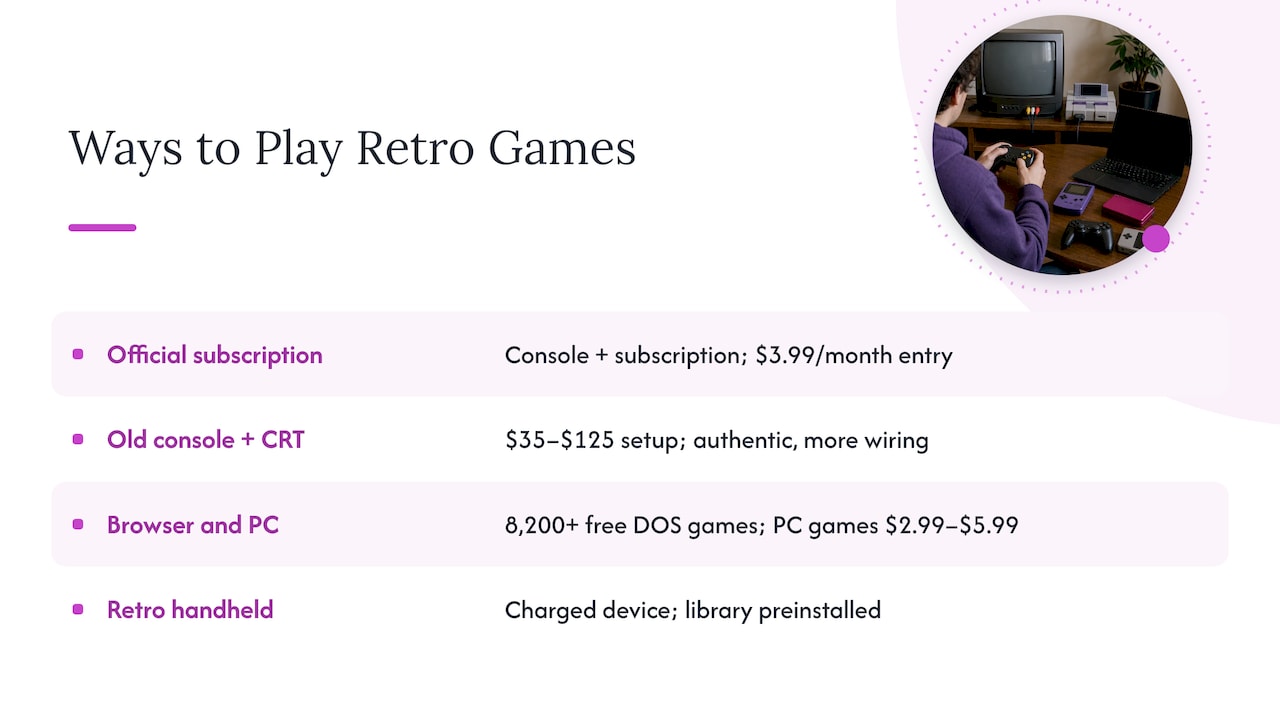
There are several routes, and each has a different trade-off between cost, effort and convenience.
Official classics subscriptions. A subscription on a modern console gives you a rotating library of classics with helpful features like save states. In the US, the entry plan is priced at $3.99 a month, $7.99 for three months or $19.99 a year, with a family plan at $34.99 a year for up to eight accounts. The higher tier, which adds N64, Game Boy Advance and Genesis libraries, costs $49.99 a year for an individual and $79.99 for a family. Prices were published in 2025, so check the current page. It also requires a compatible console and keeps you subscribed to keep playing.
Old consoles and CRTs. A budget tube-TV setup can cost as little as $35 to $125 in the US, counting a free-to-$30 TV, a $20 to $40 PS1 and $5 to $30 per game. It is authentic, but you will hunt for cables, TVs and cartridges, and there is more to hook up.
Browser and PC classics. A free library of more than 8,200 DOS games can be played in your browser, and a digital store offers preconfigured old PC games at low prices like $2.99 to $5.99. These are PC games, though, so you will not find Mario or Kirby there.
A preloaded retro handheld. One device, a charged battery and a library already installed. This is the route we built the Retro Pulse for, and it is explained below.
One reason availability matters: a 2023 Video Game History Foundation study, as reported by a retro blog, found that only about 13% of classic US games released before 2010 are still commercially available. Many classics are hard to find in any one place, so a single device with a wide library saves a lot of searching.
What to expect from the controls
Controls are where new players often stumble. A few things help:
- Learn the D-pad. Most classic games were built around a cross-shaped pad, not an analog stick. A real D-pad makes platformers feel right.
- Expect two or three buttons. NES games use A and B. SNES adds X, Y and shoulder buttons. N64 and PS1 games bring in sticks and triggers.
- Give 3D a patient first hour. Early 3D cameras and movement feel different from modern games. Choose Banjo-Kazooie-style platformers over experimental titles to ease in.
- Use saves wisely. Many old games have no checkpoints. Learn how in-game saves and save states differ in our guide to save states on a handheld, and protect long adventures with these save backup tips.
Where the Retro Pulse fits
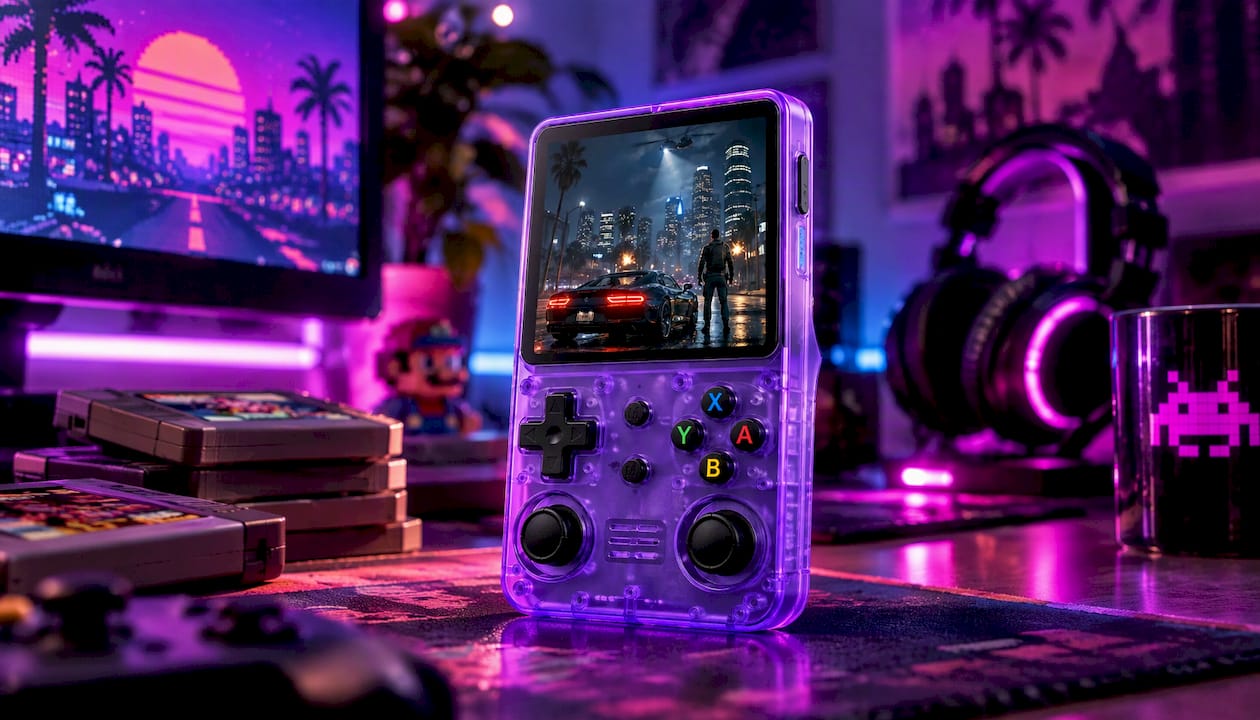
The Retro Pulse is our handheld, preloaded with 15,000 classic games from more than 20 systems, including NES, SNES, Genesis, PS1, N64, Game Boy, GBA and Arcade. It has a 3.5-inch IPS display, a real D-pad, twin sticks and L/R triggers, a removable battery rated at 6 to 8 hours, and USB-C charging. The systems that the games on this list started on, from Game Boy and NES to SNES, N64 and Arcade, are among the systems it covers.
Our view: the best first game is the one you actually start
Most people who say they want to try retro games never do, and it is rarely about the games. It is the setup: finding a console, sourcing cables, hunting for a game, learning a menu, signing up for something. By the time everything works, the excitement is gone.
That is why we built the Retro Pulse around one idea: press power and play. The library is curated and loaded already, it works offline, and there are no downloads or subscriptions between you and Super Mario World. A real D-pad and sticks mean the controls feel like the original games, which is what makes old platformers click for a beginner.
We also ship from a U.S. warehouse, so you are not waiting weeks on a package, and every unit comes with a one-year warranty and 30-day returns. We think a first retro experience should feel easy, and a handheld that fits in a bag makes a quick Tetris round on a commute or a Mario level with your kid on the couch a normal thing to do.
Sean
Get started with the Retro Pulse
If you want to try the games above without building a setup, the Retro Pulse is made for that. It comes preloaded with 15,000 games across 20+ systems, runs offline, and has dual microSD slots if you want to add games later. Orders ship from our U.S. warehouse with a one-year warranty and 30-day returns.
Not sure whether a handheld suits you? Our retro handheld buying guide walks through what to look for, and the comparison of a Switch against a retro handheld breaks down per-game costs for US buyers. Shopping for someone else? See our retro gaming gift ideas.
A simple first-week plan
If you want a path rather than a pile of choices, try this:
- Day 1: Play Kirby’s Dream Land to the end of the first world. Notice how quickly the controls come back or click.
- Day 2 and 3: Play Super Mario Bros. world 1 and Tetris for ten minutes each. Short wins matter.
- Day 4 and 5: Try Super Mario World with a friend or child taking turns.
- Day 6: Pick a harder game, such as Mega Man 2 or Banjo-Kazooie, and see how you do.
- Day 7: Start A Link to the Past and play for 30 minutes. If you enjoy the world, you are officially hooked.
Do not aim to finish games in the first week. Aim to find out which type you like: jumping, puzzles, racing or exploring. That tells you where to go next.
FAQ
What is the easiest retro game to start with?
Kirby’s Dream Land is ranked the easiest retro game to get into by one list. Its tone is bright, the difficulty is low and it is short. Super Mario Bros. and Tetris are close behind.
Are retro games good for kids?
Many are. Super Mario World is noted for bright visuals, short levels and family friendliness, and Kirby games are gentle. Let the child pick the game and play together for the first session.
Do I need an old console to play retro games?
No. You can use an official classics subscription on a modern console, a PC store, or a preloaded handheld like the Retro Pulse, which has its games already on the device and works offline.
Which retro games are good for short sessions?
Tetris is the standard answer, since it works for five-minute breaks or long sessions. Pac-Man rounds are also quick, and so are most single Mario levels.
Why are some old games so hard?
Many early games were built around repetition and competition rather than progress, so they can feel dry to newcomers. Start with games that have checkpoints or saves, and move to the tougher ones once you have your footing.
Sources
- 10 Best Retro Games for Beginners, Ranked (CBR)
- Top intro retro games for beginners (Destructoid)
- 5 NES Games That Are 10/10 (ScreenRant)
- 9 Easiest NES Games (TheGamer)
- Best Nostalgic Games (Playable Today) (Digital Citizen)
- The Official Site for PAC-MAN
- PAC-MAN 45 Years Of Impact (Bandai Namco)
- New to retro? Start here (Video Games Are Rad)
- Nintendo Switch Online, Explained (IGN)
- CRT Gaming on a Budget in 2026
- How to Play Classic DOS Games for Free (PCMag)
- Retro Gaming in 2026: The Complete Guide