Whether you owe import fees on a game console depends on where it’s made, how it reaches you and what it’s worth. The base U.S. duty on consoles is 0%, but extra tariffs on goods from certain countries can raise the real cost. When you order from a seller abroad, you are usually the importer who has to pay. When a console ships from a U.S. warehouse, you avoid that border-crossing step entirely.
This guide explains the rules in plain terms: the duty rate, the tariff layers on top, the processing fees, what changed with the de minimis exemption, and what to check before you order.
TL;DR
- Video game consoles fall under HTS code 9504.50.0000, which has a general duty rate of Free (0%). Additional tariffs depend on the country of origin.
- The $800 de minimis exemption no longer applies to covered shipments as of August 29, 2025, so small foreign orders can now be charged duties, taxes and fees.
- The importer is ultimately responsible for paying any duty owed. On a foreign order, that is often you.
- A price that includes shipping does not include duty or clearance costs. Ask the seller who pays before you check out.
- Retro Pulse ships from a U.S. warehouse, so your order doesn’t arrive as an international parcel.
Table of Contents
- The short answer: is there a U.S. import fee on game consoles?
- Base duty versus tariffs: why the rate isn’t the whole story
- How import duty is calculated on a console
- Customs fees on top of duty
- The de minimis change: why small orders are no longer “free”
- When and how you pay
- Checklist before ordering a console from abroad
- Other costs that look like import fees
- Buying Retro Pulse without a customs step
- Ready to play, shipped from the U.S.
- Our perspective
- FAQ
- Sources
The short answer: is there a U.S. import fee on game consoles?
There is no single “console import fee.” Several separate charges can apply, and each depends on different facts.
- The base duty. Consoles, controllers and gaming accessories are classified under HTS 9504.50.0000, with a Column 1 General (MFN) rate of Free. That is the rate for most trading partners.
- Additional tariffs. These stack on top of the base rate and change with trade policy. They are what most news stories about console prices are about.
- Processing fees. Customs charges a merchandise processing fee on most entries, and a harbor fee on ocean cargo.
- Carrier or broker charges. Couriers and customs brokers can bill for advancing the duty or handling the paperwork.
So a console can carry 0% base duty and still produce a bill at your door. The sections below take each layer in turn.
Base duty versus tariffs: why the rate isn’t the whole story
The 0% figure is the “normal trade relations” rate. Other measures sit on top of it for goods from specific countries.
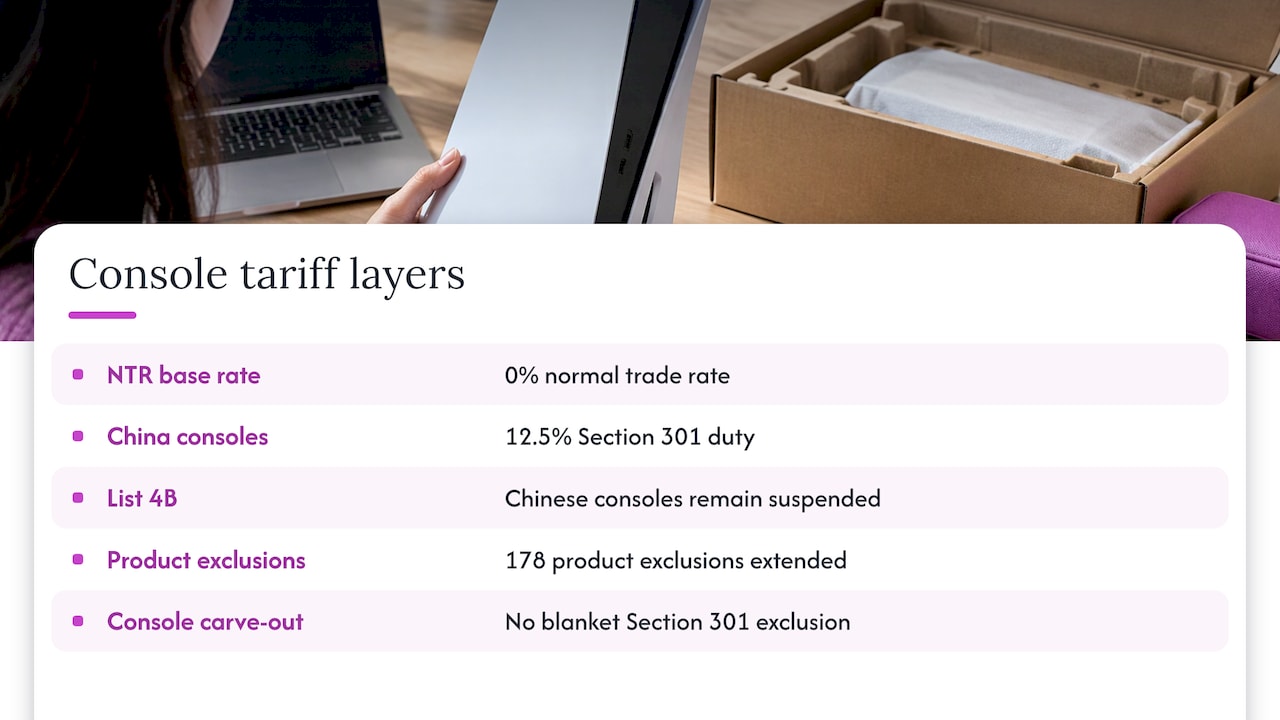
For consoles made in China, the main extra layer has been the Section 301 tariffs. One customs-industry guide reports that Chinese-origin consoles remain suspended from the List 4B duties but face a 12.5% Section 301 duty under heading 9903.05.31, effective July 24, 2026, because they are not on the exemption list in U.S. note 52(b). A separate tariff-lookup page lists the same 12.5% total effective rate for China-origin consoles under 9504.50.00.
Exclusions from Section 301 duties exist for some products. The U.S. Trade Representative has extended 178 product exclusions, but that is a list of specific products, not a blanket carve-out. An industry guide notes that the Entertainment Software Association keeps lobbying for relief, yet no blanket exclusion for consoles exists under Section 301.
Tariff policy has moved quickly in recent years and these rates can change again. Before a large purchase, confirm the current rate on the official Harmonized Tariff Schedule or with a licensed customs broker.
How import duty is calculated on a console
The math is simple once you know the inputs.
Duty = duty rate × customs value.
Customs value is normally the transaction value: the price paid or payable for goods sold for export to the United States. It is generally on an FOB basis, which means international freight and insurance are left out. Transaction value does include items such as packing costs, selling commissions and certain royalties or license fees that are a condition of the sale.
A worked example
Take a hypothetical handheld console with a customs value of $150, made in a country where a combined 12.5% rate applies:
- Duty: $150 × 12.5% = $18.75
- Add any processing fee and carrier handling charge on top
If the same console came from a country with only the 0% base rate, the duty line would be $0. The processing fee and carrier charges could still apply. This is an illustration of the formula, not a quote for any product.
Customs fees on top of duty
Two U.S. fees are calculated on value rather than on the duty you paid.
| Fee | What it is | Rate or amount |
|---|---|---|
| Merchandise Processing Fee (MPF), formal entry | Charged on formal entries, generally over $2,500 | 0.3464% of value, with a minimum of $34.58 and maximum of $670.83 for fiscal year 2027 |
| MPF, informal entry | Shipments valued at $2,500 or less | For fiscal year 2026: $2.69 automated, $8.06 manual, $12.09 manual prepared by CBP |
| Harbor Maintenance Fee (HMF) | Ocean cargo only | 0.125% of cargo value, not charged on air, truck or rail arrivals |
A consumer ordering one handheld by air or mail will usually fall in the informal-entry range, so these government fees are small. One more point from a tariff consultancy: MPF and HMF are calculated independently of Section 301 and other additional duties, based on customs value alone. The amounts are adjusted each fiscal year, which starts October 1, so check the current figures on the CBP site.
The fees that surprise people most are often the private ones. Carriers and brokers can charge a service fee for clearing the package and advancing the duty. CBP warns that first-time importers are often surprised by bills for duty, the merchandise processing fee and broker service charges.
The de minimis change: why small orders are no longer “free”
For years, shipments valued at $800 or less could enter without duty. That is no longer the case for covered shipments.
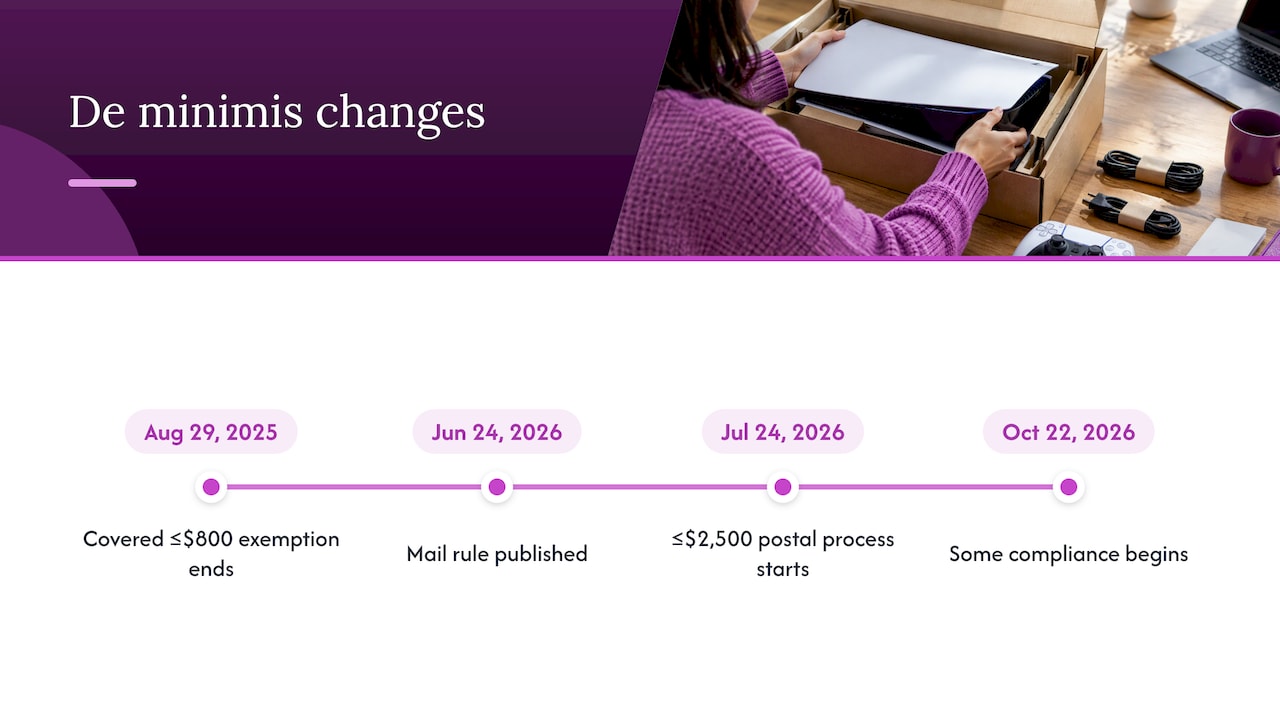
As of August 29, 2025, the de minimis exemption no longer applied to covered products valued at $800 or less, regardless of country of origin or mode of transport. Non-postal shipments became subject to the applicable duties, taxes and fees. Postal shipments became subject to the specified postal duty rates.
The rule was extended to the mail stream in 2026. CBP published an interim final rule on June 24, 2026 that indefinitely suspends the de minimis exemption for mail shipments valued at $800 or less. It also creates a postal informal entry process for certain merchandise valued at $2,500 or less, effective July 24, 2026, with compliance for some provisions starting October 22, 2026.
Two exceptions matter to shoppers. The suspension does not affect the exemptions for bona fide gifts or for personal and household articles accompanying travelers. A console you buy online and have shipped does not count as either one.
When and how you pay
Timing depends on how the package travels:
- Postal shipments: duty and processing fees are usually paid at the local post office when the package arrives.
- Courier shipments: the courier either bills you for duty it paid on your behalf or asks for payment on delivery.
That comes straight from CBP’s guidance on internet purchases. The key point is that the importer is ultimately responsible for the duty. If the seller ships “delivered duty unpaid,” that importer is you.
A large or heavy item adds freight on top. If you are comparing the cost of moving bulky equipment, this overview of how shipping costs add up for large items shows how quickly carrier charges grow with size and distance. A handheld is compact, but the same logic applies: delivery, duty and handling are separate lines.
Checklist before ordering a console from abroad
CBP suggests buyers confirm a few basics. Turn them into questions for the seller:
- Can it be legally imported? Confirm the product meets U.S. rules.
- Personal or commercial use? The answer can change how the shipment is handled.
- Who ships it and how? Ask about the carrier, the expected delivery window and any customs paperwork.
- Will the seller give accurate customs information? The declared value and description on the paperwork should match what you bought.
- Is duty included in the price? Ask whether the quoted total covers duty, or whether you pay the carrier on arrival.
- Where was the console made? The country of origin, not the seller’s location, drives the extra tariff layer.
Remember that a price that includes shipping and handling does not include duty or the cost of clearing the goods. Get the full landed cost in writing where possible.
Other costs that look like import fees
Some charges buyers blame on customs have other causes:
- Return shipping. Sending a console back across a border can cost more than the original delivery, and you may need to deal with customs paperwork again.
- Warranty service abroad. If a seller is overseas, a repair can mean paying freight both ways.
- Wrong-region hardware. Differences in video standards and power can matter for collectors. Our guide to PAL vs NTSC and why 50 Hz vs 60 Hz matters explains what to look for.
Before you buy anywhere, read the return terms. Ours are laid out in our console return policy for U.S. buyers, and the coverage details are in the handheld console warranty guide.
Buying Retro Pulse without a customs step
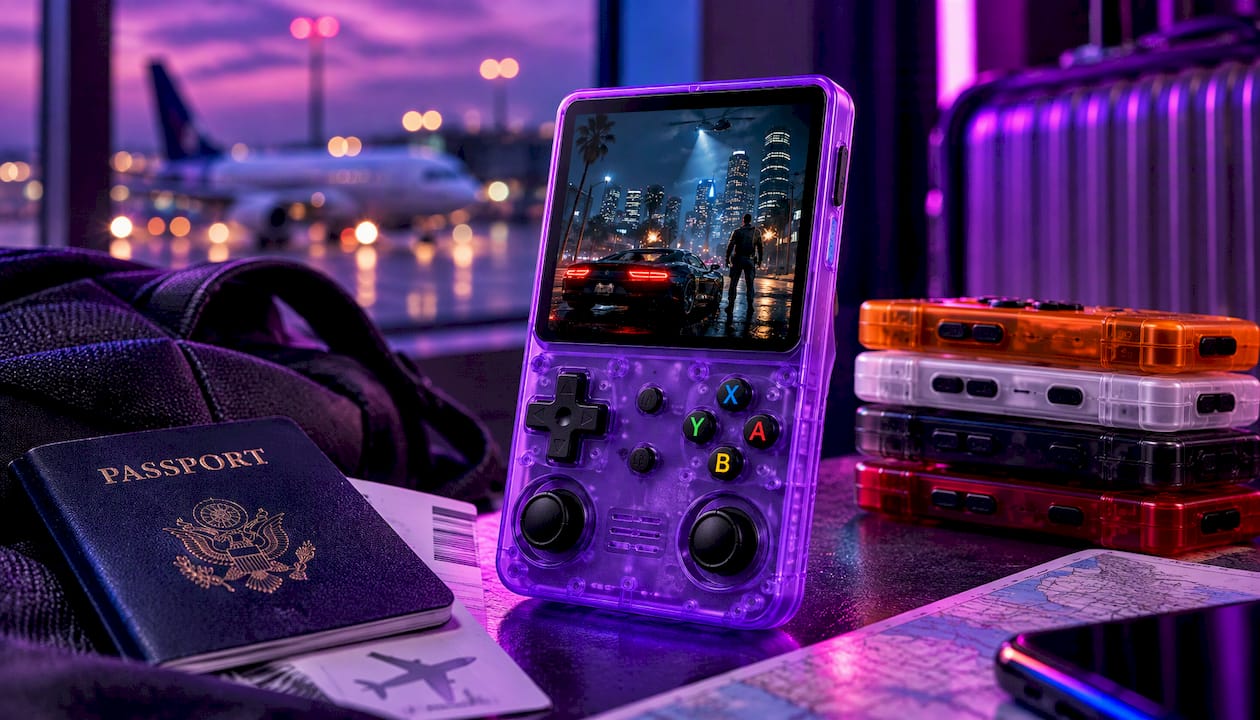
Retro Pulse ships from a U.S. warehouse. For a U.S. buyer, that means the order doesn’t arrive as an international parcel, so there is no courier collecting customs charges at your door and no waiting on a package held at the border. Shipping from inside the country also avoids the long waits that buyers often report with overseas suppliers.
Here is what comes with it:
- 15,000 preloaded classic games from over 20 systems, including NES, SNES, Genesis, PS1, N64, Game Boy, GBA and Arcade
- A 3.5" IPS display with a real D-pad, twin sticks and L/R triggers
- A removable battery rated for 6 to 8 hours, with USB-C charging
- Dual microSD slots for adding your own games
- Offline-first play: no downloads, no subscriptions
- A one-year warranty and 30-day returns
Ready to play, shipped from the U.S.
If you want a retro handheld that arrives ready to play, see Retro Pulse. Check the product page for current pricing and availability.
Still deciding between a retro handheld and a mainstream console? Our comparison of a retro handheld versus a Switch-style console breaks down 15,000 games against per-game costs. If you have questions about preloaded devices, our guide on what to check with preloaded consoles covers the details.
Our perspective
Most people don’t shop for a console thinking about tariff codes. They shop for a good evening of play, or for a gift that works the moment it comes out of the box. Then a surprise bill from a courier turns a simple purchase into a headache.
That is a big reason we ship Retro Pulse from a U.S. warehouse. We would rather you spend your attention on the games than on customs forms, carrier notices or a package stuck in transit.
We also built Retro Pulse around a simple idea: retro gaming shouldn’t need setup. It comes loaded with a curated library of 15,000 games, plays offline, and has real controls, a bright 3.5" IPS screen and a removable battery you can swap for longer sessions. Parents can hand it to a kid and share the games they grew up with. Commuters can slip it in a bag. Students get a lot of play for the money.
Our advice is the same whatever you buy: know who ships it, where it comes from, and what happens if you need to return it. We stand behind Retro Pulse with a one-year warranty and 30-day returns.
Sean
FAQ
Is the U.S. still charging import fees on game consoles?
Yes, though what you pay depends on origin and shipping method. The base duty for consoles is 0%, but additional tariffs, such as Section 301 duties on China-origin goods, can apply on top. Processing fees and carrier charges may also appear. Confirm current rates with CBP or a licensed customs broker.
How much can I import to the U.S. without paying duty?
The old $800 de minimis threshold no longer applies to covered shipments. It was removed as of August 29, 2025 and later suspended for mail shipments too. Bona fide gifts and personal articles carried by travelers are treated separately.
Who pays the import fee, the seller or the buyer?
The importer is responsible for paying duty. On many foreign orders that is the buyer, unless the seller explicitly ships with duties prepaid. Ask before you pay, because shipping charges in the price don’t cover customs costs.
Do I pay import fees if a console ships from a U.S. warehouse?
A package that ships from inside the U.S. doesn’t cross the border on its way to you, so you aren’t clearing it through customs at delivery. That is how Retro Pulse is fulfilled. For the details of your own order, check the checkout page and our return terms.
Sources
- USTR notice extending Section 301 product exclusions
- Import duty from China to the USA: tariff guide
- Video game HS code: tariffs, trade and logistics tips
- HTS 9504.50.00 video game consoles
- HTS 9504.50.0000 duty rate
- U.S. Customs and Border Protection: Internet purchases
- Customs value: transaction value guidance
- U.S. import duties, taxes and fees explained
- CBP fiscal year 2027 customs user fee increases
- Merchandise processing fee rates, limits and exemptions
- MPF and HMF fees explained
- Federal Register: end of de minimis exemption, August 2025 notice
- Federal Register: indefinite suspension of de minimis for mail shipments