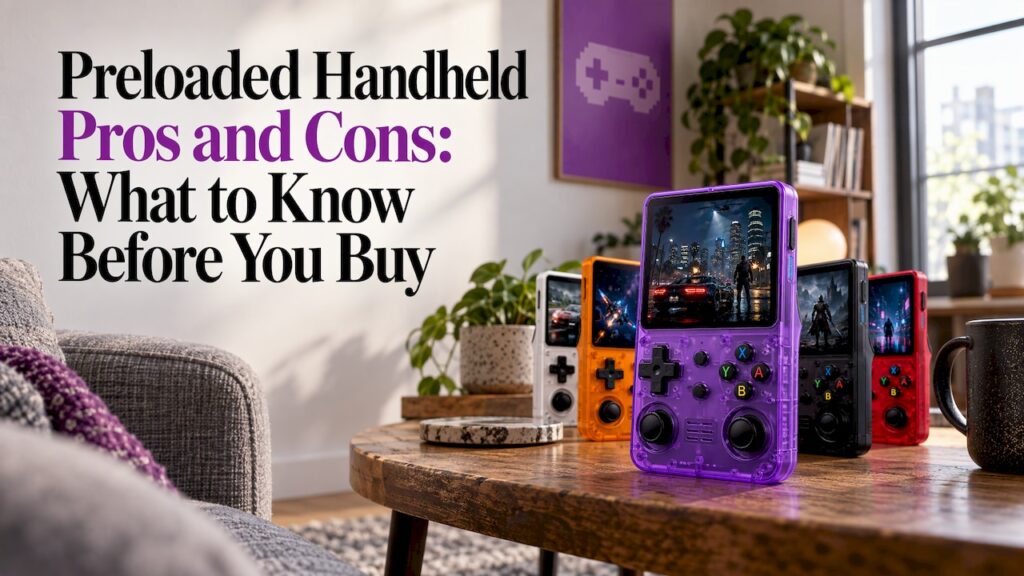
A preloaded handheld is a pocket console that arrives with its games already installed, so you charge it, switch it on and play. The big advantage is zero setup. The thing to get right is the quality of the library, the storage and the support behind the device. A curated library, a U.S. warehouse and a real warranty cover all three, and that is how we built the Retro Pulse: 15,000 classic games from over 20 systems, ready to play out of the box.
TL;DR
- Biggest pro: you skip the setup project of downloading emulators, files and menus. You can play within minutes of opening the box.
- Biggest con to avoid: a huge game count can hide duplicates, regional copies and games that will not load. A curated library avoids that.
- Check the storage: many preloaded devices run from a microSD card, so card quality and a second slot matter.
- Check the seller: a U.S. warehouse, a written warranty and a return window decide what happens if something goes wrong.
- Battery and screen: a 3.5" IPS display and a battery that swaps out make a handheld work for commutes, car rides and trips.
Table of Contents
- What a preloaded retro handheld is
- The pros of a preloaded handheld
- The cons of a preloaded handheld, and how to avoid each one
- Pros and cons at a glance
- Preloaded versus the other ways to play
- Who a preloaded handheld suits best
- A short checklist before you buy any preloaded handheld
- Get the Retro Pulse
- Our perspective
- FAQ
- Sources
What a preloaded retro handheld is
A retro handheld plays old games from systems such as the NES, SNES, Genesis, Game Boy and PlayStation. It does this with software called an emulator, a program that behaves like the original console. The games themselves are files, often stored on a microSD card, which is the same tiny memory card used in phones and cameras.
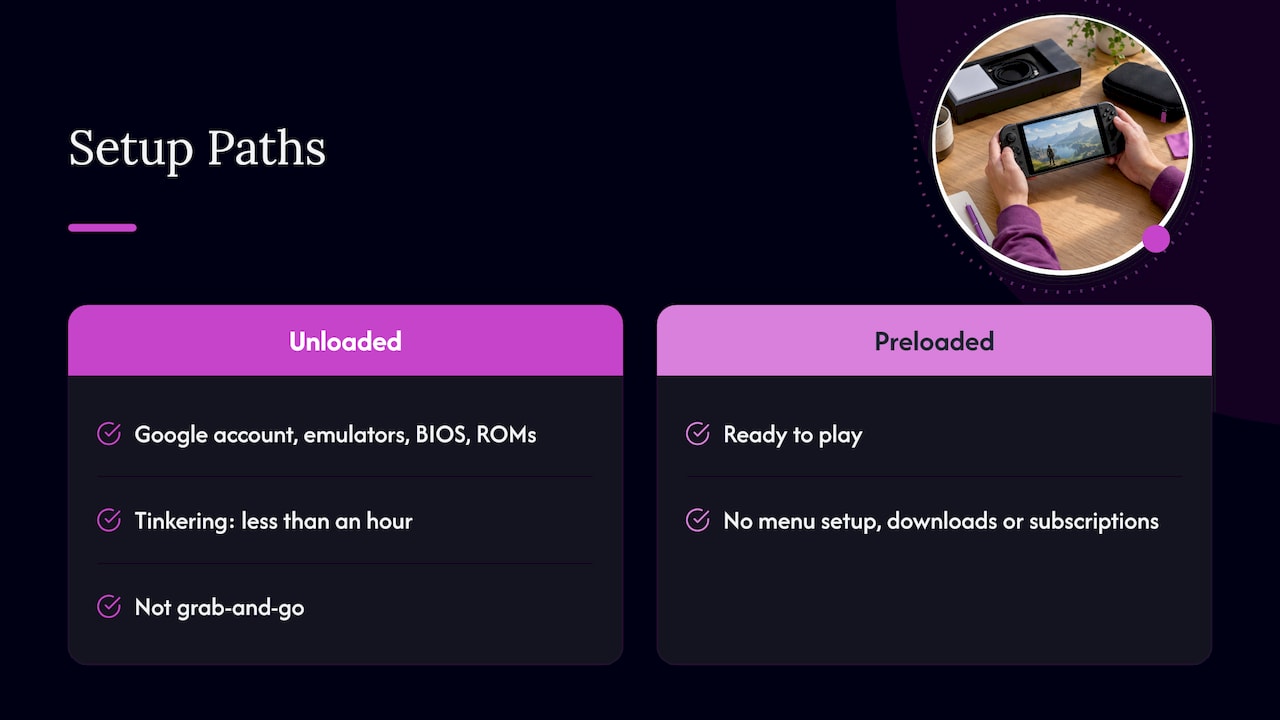
“Preloaded” means the maker has already installed the emulators, organized a menu and put the game files on the device. “Unloaded” devices ship empty. You then find emulators, sort out your own files and build the menu yourself.
That is the whole difference, and it explains nearly every pro and con below. Preloaded means convenience, and it also means you are trusting someone else’s choices about what goes on the device.
The pros of a preloaded handheld
1. Setup is done before it reaches you
A setup-heavy handheld is a real project. One 2026 review of a popular unloaded handheld describes a first-time setup involving a Google account, emulators, BIOS files, ROMs and a front-end choice, and says it is not a grab-and-go console. A major outlet’s reviewer found the same kind of device needed less than an hour of tinkering thanks to plenty of video tutorials. Fine for a hobbyist. For a parent, a commuter or someone buying a gift, an hour of menus is the reason many people never start.
A preloaded device removes that hour. The Retro Pulse is ready to play with no menu setup, no downloads and no subscriptions. If you want the plain-English version of what setup involves on other devices, our emulation handheld setup guide walks through it.
2. One purchase covers many systems
One device that plays NES, SNES, Genesis, PS1, N64, Game Boy, GBA and arcade games replaces a shelf of old hardware. A Pocket-lint review of a preloaded handheld called it one of the simplest and cheapest ways to get started with retro gaming, and said that for the price of a single new console game, the value is hard to deny.
That matters for students and anyone on a budget. Buying classic games one at a time on a modern console adds up quickly. We compare the two approaches in our guide on a retro handheld versus a Switch.
3. Offline play, no accounts
An offline-first handheld has no store to browse, no login and no download queue. For kids, that means no accidental purchases and nothing to distract them from the game. For a commuter, it means it works in a tunnel, on a plane or on a long car ride.
4. A screen made for old games
Most retro games were designed for small, low-resolution screens, so a 3.5-inch display fits them well. Reviewers of 3.5-inch handhelds are consistently positive: one praised the IPS display for making games look stellar with no lag, even during pre-rendered cut scenes. IPS is a panel type known for good colors from wide viewing angles, which helps when a child is looking over your shoulder. Our page on what matters in retro handheld screen quality covers the details.
5. Easy to share across generations
This is the reason a lot of parents buy one. You can hand a child the same game you played at their age without teaching them a menu system. The controls are real buttons, a D-pad and sticks, which are simpler for small hands than touchscreen overlays. Parents who want a side-by-side look can read our retro handheld comparison for parents.
The cons of a preloaded handheld, and how to avoid each one
Every category has trade-offs. With preloaded handhelds they come down to a few predictable things. Each is something you can check before you buy.
1. Inflated game counts
The most common problem is a big number that is not what it seems. Android Authority writes that devices advertising 10,000 games are almost guaranteed to include filler, such as games that will not load, foreign-language versions and badly named files that can confuse the menu software.
A 2026 review makes the same point with numbers. It found one title appearing as six separate files, covering regional versions, a translation, a hack and a bootleg, so a claimed 28,000-game library could shrink to a few thousand unique titles. The reviewer also notes the manufacturer publishes no official game list.
What to look for: a curated library, meaning someone selected and tested it instead of dumping every file they could find. The Retro Pulse library is curated, and each unit is reviewed and tested for quality. The headline count matters less than whether the games you actually want run well.
2. Cheap storage cards
Most preloaded handhelds keep their games on a microSD card. Android Authority warns that cheap cards bundled with some devices have high failure rates, with most lasting only a few months. On some Linux-based systems the card also holds the operating system, so a failed card can leave the device unusable.
What to look for: a device with a warranty that stands behind it, and room to grow. The Retro Pulse has dual microSD slots, so you can add games of your own later. Our guide on adding games to a retro handheld explains how, and it keeps you from ending up with a blank game list.
3. Battery life that does not match the box
Battery life depends heavily on which system you play. In one review of a different preloaded handheld, the reviewer found roughly two to three hours of play on Nintendo DS emulation, stretching to four or five on lighter consoles like the NES. Heavier systems such as N64 and PS1 draw more power than 8-bit games do.
What to look for: a stated range, a USB-C charger and, ideally, a battery you can swap. The Retro Pulse has a removable battery with a 6 to 8 hour life and charges over USB-C. You can carry a spare for a long trip and keep playing.
4. Build and controls that feel cheap
Buttons that stick, a D-pad that feels mushy or a plastic body that creaks are common complaints with budget devices. Old games are unforgiving: platformers and fighting games need a precise D-pad.
What to look for: a real D-pad, twin sticks and L/R triggers, plus a body built to take being dropped in a backpack. The Retro Pulse has all three controls and a robust design.
5. Seller and warranty risk
This is the con that gets the least attention and causes the most grief. Many preloaded handhelds are sold by marketplace sellers who ship from overseas. If the device fails, there may be nobody to contact. A 2026 consumer-electronics review site notes that for U.S. buyers the biggest practical risk is a seller who disappears mid-warranty.
What to look for: a seller in your own country, a written warranty and a return window. The Retro Pulse ships from a U.S. warehouse, which avoids the long shipping waits and quality problems we associate with overseas suppliers. It comes with a 1-year warranty and 30-day returns. Our page on what the handheld warranty covers and how to claim explains the process step by step.
For a wider look at safety, including the three checks we think matter most, see our guide to preloaded console safety.
Pros and cons at a glance
| What you care about | Why a preloaded handheld helps | What to check | What the Retro Pulse offers |
|---|---|---|---|
| Setup time | Ready to play out of the box | Whether the menu is organized | No menu setup, downloads or subscriptions |
| Library | Many systems in one device | Duplicates, filler, games that fail | Curated 15,000 games from over 20 systems |
| Storage | Games already on the card | Card quality, room to add games | Dual microSD slots |
| Battery | Plays offline anywhere | Hours per system, charging type | Removable battery, 6 to 8 hours, USB-C |
| Support | One purchase, no tinkering | Seller location, warranty, returns | U.S. warehouse, 1-year warranty, 30-day returns |
Preloaded versus the other ways to play
There are three other common routes to classic games, and each suits a different person.
Your phone. It is free to start but has no physical buttons, and you still have to find emulators and files. We cover the trade-offs in phone emulation versus a handheld.
A mini console for the TV. Great for the living room, but it stays there. Our comparison of a mini console versus a handheld shows when each makes sense.
A high-end PC handheld. These are powerful, but expensive. One 2026 report on a major PC handheld’s price increase to $789 to $949 said buying one only for emulation is hard to justify. Setup is also still on you.
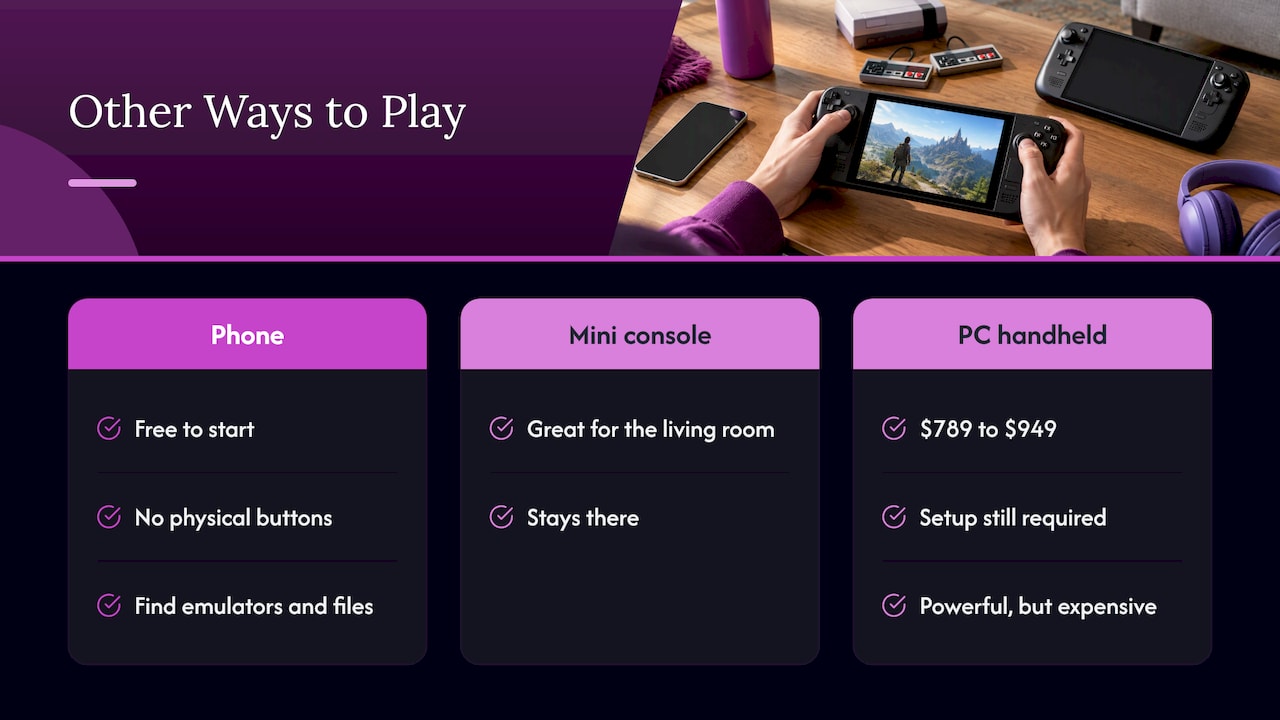
If your goal is simply to play classic games with the least friction, a preloaded handheld is the shortest path.
Who a preloaded handheld suits best
- Retro gamers with limited time. You want the games, not a weekend of configuration.
- Parents. Hand over a device with real buttons, no store and no accounts.
- Commuters. Offline play and a swappable battery fit a daily train or bus ride.
- Students. One purchase replaces a pile of old consoles and cartridges, which suits a tight budget.
- Gift buyers. It is a gift that works the moment it is unwrapped, so you do not need to know anything about emulation.
A short checklist before you buy any preloaded handheld
- Is the library curated and tested? A smaller, working set beats a giant, messy one.
- Can you add your own games? Look for a second microSD slot.
- What is the stated battery life, and can you swap it? Heavier systems drain faster.
- Where does it ship from? A U.S. warehouse means faster delivery and an easier return.
- What is the warranty and return window? Get both in writing.
- Do the controls suit the games you love? A real D-pad and triggers matter.
Get the Retro Pulse
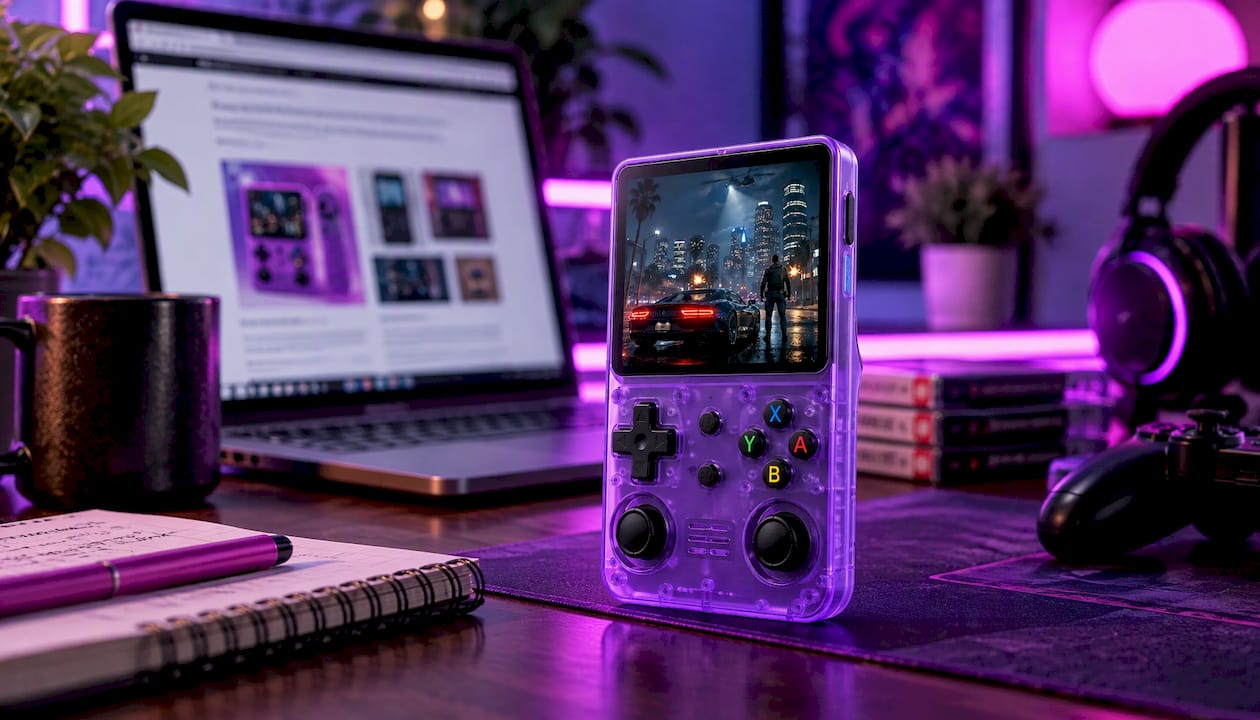
The Retro Pulse is our answer to that checklist: 15,000 curated games from over 20 systems, a 3.5" IPS display, a real D-pad, twin sticks and L/R triggers, a removable battery with 6 to 8 hours of play, USB-C charging, dual microSD slots, a 1-year warranty and 30-day returns. It ships from a U.S. warehouse. You can see the details on the Retro Pulse product page.
If you want to play arcade classics in particular, our page on arcade emulation on handhelds shows what to expect.
Our perspective
We built the Retro Pulse around one idea: nobody should need a tutorial to play a game they loved as a kid.
Most people who want a retro handheld do not want a hobby. They want to press a button and see a title screen. That is why we chose a curated library over the biggest possible number, why the device is offline-first, and why there is no subscription or download step.
We also think the support behind a handheld matters as much as the hardware. A device that ships from a U.S. warehouse, comes with a 1-year warranty and has a 30-day return window removes the biggest worry about buying this kind of product.
The result is something a parent can hand to a child, a commuter can drop in a bag and a gift buyer can wrap without a second thought. A preloaded handheld done well is the simplest way to play the classics, and that is the standard we hold the Retro Pulse to.
Sean
FAQ
Are preloaded handhelds worth it?
For most people who want to play classic games without setup, yes. You pay once and get many systems in one device that works offline. Value depends on a curated library, decent storage and a warranty you can use.
Does a bigger game count mean a better handheld?
Not by itself. Large counts often include duplicates, regional versions and games that do not run, so the number of unique, working titles is what counts. A curated library of 15,000 games is built so the list you see is the list you can play.
How long does the battery last on a retro handheld?
It depends on the system you play. Older 8-bit and 16-bit games use less power than PS1 or N64 games, so play time shrinks as the games get more demanding. The Retro Pulse has a removable battery rated at 6 to 8 hours, and you can swap it for a charged one.
Can I add my own games to a preloaded handheld?
On the Retro Pulse, yes. It has dual microSD slots, so you can add games alongside the preloaded library. Our guide on adding games to a handheld explains the steps.
What happens if my handheld stops working?
The Retro Pulse comes with a 1-year warranty and 30-day returns, and it ships from a U.S. warehouse. Our warranty guide explains what is covered and how to make a claim.
Sources
- Here’s why I never buy retro gaming handhelds with pre-loaded games (Android Authority)
- Miyoo Mini Plus 2026: 6,041 Games, No Master List, 7.5/10 (Stares Back)
- Anbernic RG35XX H review (Pocket-lint)
- Anbernic RG35XX review (XDA Developers)
- Miyoo Mini Plus handheld review (GamesRadar)
- Retroid Pocket 5 review (Polygon)
- Retroid Pocket 5 review (GamePadSquire)
- Steam Deck price jumps to $789 and $949 (NoobFeed)
- Lenovo G02 retro handheld preloaded (SpecPicks)