Retro game genres are gameplay-driven categories that classify classic arcade and early-console titles by what the player actually does, not by story or graphics. The canonical set includes action, adventure, platformer, shooter, puzzle, role-playing, sports/racing, fighting, simulation, and arcade games. The sections below walk through each genre’s mechanics, the hardware history that shaped them, and the keystone titles that still define them.
TL;DR:
- The core retro genres are defined by mechanics such as jumping, aiming, solving puzzles, or managing systems, rather than by story or visuals.
- Hardware limitations shaped genre development, with arcade machines favoring short, score-based sessions, while consoles enabled longer, more complex gameplay experiences.
- Genre classification relies on core interaction, goals, persistence, and session length, making many hybrid titles difficult to categorize strictly.
- Popular titles like Donkey Kong, Space Invaders, and Zelda serve as benchmarks for their respective genres and showcase the mechanical signatures of each.
- Modern hybrids like metroidvania and battle royale build on retro mechanics, blending established genres while the labels themselves remain useful for understanding core gameplay.
Table of Contents
- 1. The Core Retro Genres and How to Spot Them
- 2. How Hardware and Business Shifts Shaped Genre History
- 3. A Mechanics-First Framework for Classifying Retro Games
- 4. Canonical Titles That Define Each Genre
- 5. How Retro Pulse Connects Players to Genre History
- 6. The Influence of Cultural and Regional Differences on Retro Game Genre Evolution
- 7. Impact of Control Schemes and Input Devices on Genre Development
- 8. Key Designers or Studios That Pioneered Certain Retro Genres
- 9. The Role of Difficulty and Player Skill in Genre Appeal
- 10. How Retro Genre Conventions Shape Modern Hybrids
- 11. How Subgenres and Genre Fragmentation Emerged
- 12. What Retro Genre Labels Still Get Right
- Play Retro Genres Instantly With Retro Pulse
- FAQ
- Sources
1. The Core Retro Genres and How to Spot Them
Every retro genre has a mechanical signature, a set of controls and goals that identifies it regardless of theme or setting. Genre classification in video games rests on gameplay interaction rather than narrative or visuals, which is why a sci-fi shooter and a fantasy shooter belong to the same category despite nothing in common on the surface.
- Action: fast reflex-based play with direct control over a character, usually combat or obstacle avoidance, scored in real time with limited lives.
- Platformer: jumping and climbing across tiered terrain, with precise control over a character’s arc and momentum as the central skill.
- Adventure: exploration and puzzle-solving through a persistent world, often slower paced, built around item collection and environmental logic.
- Shooter: aiming and firing at waves of enemies, either fixed on a plane (shoot-’em-up) or moving through space, with survival and score as the goals.
- Puzzle: pattern recognition and spatial logic under a time or move limit, usually with no combat at all.
- Role-playing (RPG): character growth through stats, equipment, and turn-based or menu-driven combat, with long-form narrative and persistence between sessions.
- Sports and racing: simulated competition using real-world rules or vehicles, scored by time, points, or match outcome.
- Fighting: one-on-one combat with move sets, timing, and a round-based win condition.
- Simulation: management or operation of a system, vehicle, or environment, usually with few explicit win conditions.
- Arcade: a catch-all retro label for short-session, score-chasing games built for coin-op cabinets, often overlapping with action or shooter mechanics.
Session structure is often the fastest way to tell these apart. A platformer or shooter typically runs in short, replayable bursts measured in minutes, while an RPG or adventure game expects hours of continuous progress saved across sittings. Controls matter too: a single joystick and one or two buttons usually signals an arcade-era action or shooter title, while a full directional pad plus multiple face buttons points toward a console-era fighting game or platformer.
Each genre mattered in its own way during the retro era. Arcade and shooter games drove coin-op revenue through short, replayable sessions designed to consume quarters quickly. Platformers became the signature genre of early home consoles because they showcased precise character control within tight memory budgets. Adventure and RPG titles pushed hardware forward, since their persistence requirements forced the save-system innovations that later genres depended on. Sports and racing games sold consoles to households that wanted familiar, rules-based competition rather than abstract score chasing. Puzzle games found a home on nearly every system because their low memory and processing needs made them cheap to produce and easy to port.
2. How Hardware and Business Shifts Shaped Genre History
Retro genres did not appear fully formed. They emerged in response to the limits and opportunities of each hardware generation, and tracing that sequence explains why certain genres cluster around certain eras.
- Arcade era (early 1970s to early 1980s): Coin-operated cabinets demanded short, intense sessions that justified another quarter, which produced the scoring, lives, and instant-death conventions behind early action and shooter genres. Pong, Spacewar!, and the mass-market rise of Atari established the template for arcade-style play.
- 8-bit console era (early to late 1980s): Home cartridges allowed longer, more varied experiences than coin-op hardware, and the genre that benefited most was the platformer. Donkey Kong in 1981 and Super Mario Bros. in 1985 established the jump mechanic and level-design conventions that still define platforming today.
- 16-bit era (late 1980s to mid-1990s): Expanded memory and processing power let designers build larger worlds and more complex combat systems, which is when fighting games, action-RPGs, and sprawling platformers reached their peak. Battery-backed save chips on cartridges were the key technical unlock, since they made persistent progress possible without a password system, directly enabling the growth of RPG and action-adventure genres on consoles.
- Early 3D and PC rise (mid to late 1990s): CD-ROM storage and PC hardware with real 3D acceleration opened the door to first-person shooters and deeper simulation and strategy games that eight-bit and sixteen-bit hardware simply could not support.
Sales data from the era shows how these shifts played out commercially. Industry research from 1999 recorded strategy and role-playing games leading unit sales that year at 19.7 million units, ahead of action games at 17.1 million, sports at 8.9 million, racing at 7.8 million, shooting at 4.6 million, fighting at 4.2 million, and simulation at 3 million, a snapshot that reflects just how far RPGs and strategy titles had grown once console hardware could support them.
3. A Mechanics-First Framework for Classifying Retro Games
The most reliable way to classify a retro title is to ignore its packaging and ask what the player is actually doing moment to moment. Four axes cover most cases.
- Primary interaction: Is the player jumping, shooting, solving, managing, or racing? This single question eliminates most ambiguity immediately.
- Goal: Is success measured by score, by survival, by completion of a fixed objective, or by narrative progress?
- Persistence: Does progress carry between sessions through saves or passwords, or does each session reset to zero?
- Session length: Is the experience designed for a two-minute arcade run or a fifty-hour campaign?
Publisher labels from the era often don’t match this framework. Many cartridge boxes used the word “arcade” as a catch-all marketing term for any fast action game, even when the mechanics were closer to a platformer or shooter, and genre labels in retro catalogs were frequently fluid or inconsistent with how modern players would classify the same mechanics.
Borderline cases are common. A game with platforming traversal and RPG-style leveling is an action-adventure hybrid rather than a pure platformer, and a racing game with vehicle combat leans action-racing rather than straight simulation. When a title mixes mechanics evenly, naming both genres is more accurate than forcing a single label.
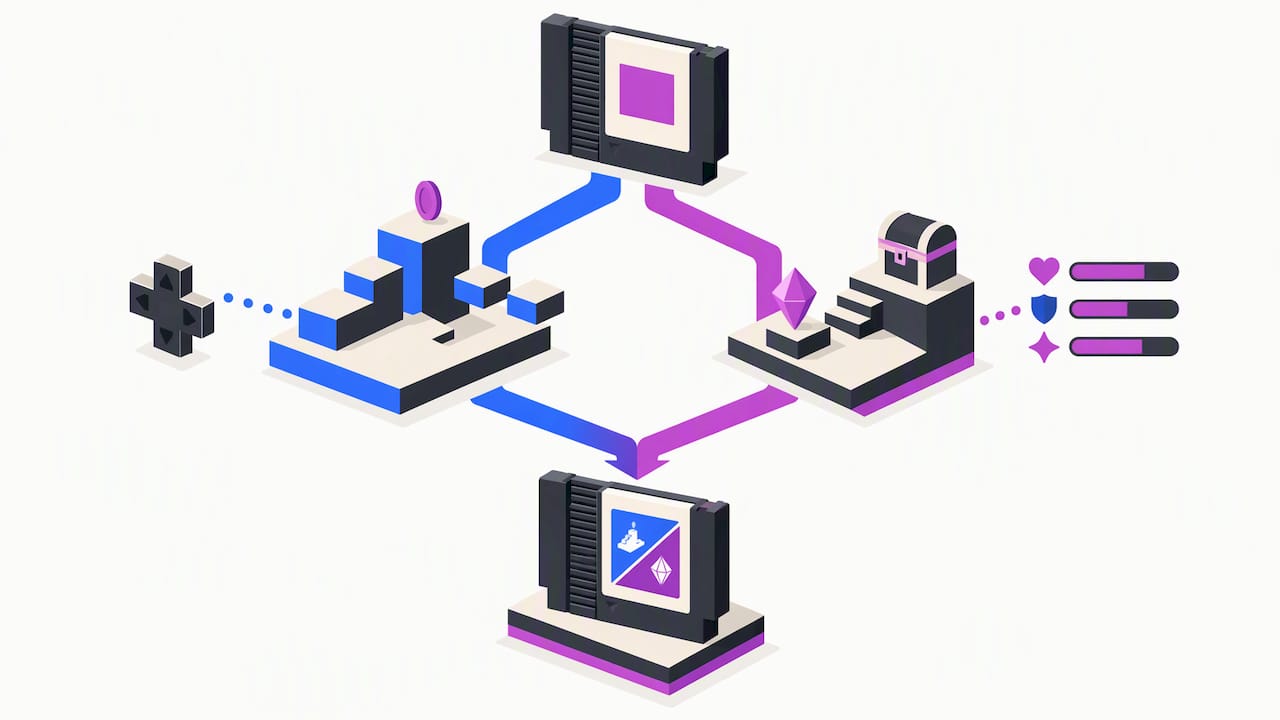
Pro Tip: When a game’s mechanics are split evenly between two genres, classify it by whichever mechanic determines failure, since that is usually the system the designer built the challenge around.
4. Canonical Titles That Define Each Genre
Matching genres to specific games makes the definitions concrete rather than abstract. Wikipedia’s broader survey of genres and subgenres confirms that many classic titles sit at the intersection of two categories rather than fitting neatly into one, but each of the following is widely treated as a benchmark for its primary genre.
- Platformer: Donkey Kong (1981) introduced the jump-and-climb structure that defined the genre, and Super Mario Bros. (1985) refined momentum-based movement and tiered level design into the standard still used today.
- Shooter: Space Invaders and Galaga established the fixed-plane shoot-’em-up pattern of advancing enemy waves and limited player mobility.
- Action-adventure: The Legend of Zelda combined exploration, item-based puzzle solving, and real-time combat into a persistent world, made possible by its early use of battery-backed saves on a cartridge.
- Puzzle: Tetris demonstrates pure spatial logic under time pressure with no combat or narrative layer at all.
- Fighting: Street Fighter II popularized the round-based, move-set-driven one-on-one format that defined the genre’s competitive structure.
- RPG: Final Fantasy and Dragon Quest built the template of stat growth, turn-based combat, and long-form persistence.
- Racing: Out Run exemplifies arcade-style racing built around checkpoints and time pressure rather than full vehicle simulation.
- Sports: early Madden and NBA titles mapped real-world rules and statistics onto a scored, match-based structure.
5. How Retro Pulse Connects Players to Genre History
Our author’s background researching and cataloging classic hardware and software informs how we approach genre history: as something best understood by playing the actual titles, not just reading about them. Archival projects back this instinct, since preservation researchers note that multiple formats, including cartridges, arcade ROMs, and community-run speedrun archives, are each essential to keeping genre history intact.
Our Retro Pulse handheld reflects that same philosophy in a single device. It ships preloaded with 15,000 games across more than 20 systems, runs offline-first so nothing depends on downloads or a subscription, and displays everything on a 3.5" IPS screen with a removable battery and a one-year warranty. For a reader trying to sample action, platformer, RPG, and puzzle titles side by side, a curated offline library removes the friction of hunting down working cartridges or emulator setups for each genre.
6. The Influence of Cultural and Regional Differences on Retro Game Genre Evolution
Genre development did not follow one path worldwide. Japanese developers leaned heavily into RPGs and vertically scrolling shooters, genres that matched console hardware strengths and found a receptive home audience, while North American and European studios gravitated toward action, platformer, and sports titles suited to arcade culture and home console ownership patterns. Arcade culture itself diverged by region: Japanese arcades remained a dominant social space well after home consoles matured, which kept score-driven action and shooter genres commercially relevant there longer than in markets where home play took over faster.
Licensing and distribution also shaped which genres crossed borders. Some Japanese RPGs never saw a Western release during the retro era because publishers doubted the genre’s appeal outside its home market, while sports titles built around American leagues rarely traveled well in the other direction. These regional gaps mean that a “canonical” genre list looking back from one market can miss titles that were foundational somewhere else, a reminder that genre history is a composite of several regional timelines rather than one single track.
7. Impact of Control Schemes and Input Devices on Genre Development
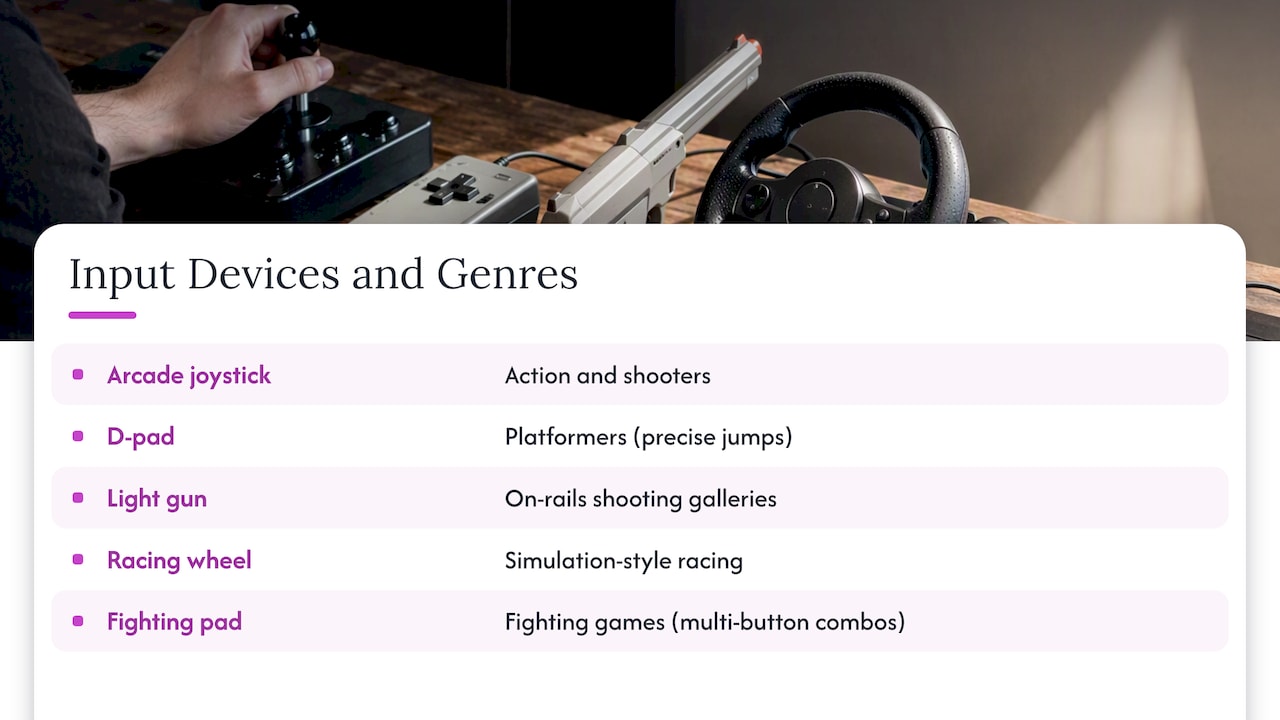
Input hardware didn’t just support genres, it often determined which ones were possible. A single joystick and one or two buttons, the standard arcade configuration, naturally produced action and shooter games built around movement and a single attack. The directional pad, standardized by home consoles, enabled the precise four-way and diagonal input that platformers depend on for controlled jumps and momentum.
Specialty peripherals opened entirely new genres. Light guns made on-rails shooting galleries possible, racing wheels and pedal sets supported more simulation-leaning racing titles, and the arrival of multi-button fighting pads with dedicated attack buttons was a direct prerequisite for the move-set complexity that defined fighting games. Without that control density, the genre would have stayed limited to simple punch-and-kick exchanges rather than developing combo systems. Each new input device effectively unlocked a genre that the previous generation’s hardware couldn’t support.
8. Key Designers or Studios That Pioneered Certain Retro Genres
A handful of design decisions, more than any single company, set the direction for entire genres. The jump-focused level design behind Donkey Kong and Super Mario Bros. established the platformer’s core grammar of momentum, timing, and tiered terrain, a template credited with shaping nearly every platformer that followed. The persistent, save-driven world of The Legend of Zelda demonstrated that action and exploration could coexist in one genre, effectively founding action-adventure as its own category rather than a variant of straight action.
Early pioneers working outside the arcade-industrial system mattered too. Ralph Baer’s prototype work on home video games in the years before Pong laid groundwork for how early hardware constraints forced the first rough genre distinctions, distinctions that later designers refined as memory and processing power grew. Fighting games owe their round-based, move-set structure to the design choices behind Street Fighter II, which turned a simple punch-and-kick exchange into a genre built on timing, spacing, and character-specific move lists. In each case, a single design choice became the mechanical rule the rest of the genre followed.
9. The Role of Difficulty and Player Skill in Genre Appeal
Difficulty wasn’t an afterthought in retro design, it was often the entire product. Arcade cabinets were built to be hard on purpose, since a quick loss meant another quarter in the machine, and that commercial pressure shaped the steep difficulty curves still associated with action and shooter genres. Home console games inherited some of that instinct even without the coin-op incentive, which is why many 8-bit and 16-bit platformers and shooters remain notoriously tough by modern standards.
Genre and difficulty expectations developed together. Puzzle games built difficulty around time pressure and pattern complexity rather than reflexes, which drew a different kind of player than a fast-twitch shooter. RPGs spread challenge across hours of stat growth and strategic choices instead of split-second reactions, appealing to players who wanted a slower mastery curve. That connection between genre and skill expression became part of the genre definition itself: a fighting game’s difficulty lives in execution and timing, while an adventure game’s difficulty lives in puzzle logic and exploration, and conflating the two misreads what each genre is actually testing.
10. How Retro Genre Conventions Shape Modern Hybrids
Modern game design borrows constantly from the mechanical vocabulary retro genres established. The “metroidvania” subgenre, named for Metroid and Castlevania, takes the platformer’s jump-and-explore structure and layers in RPG-style progression gates, a direct descendant of the action-adventure fusion Zelda pioneered decades earlier. Roguelikes borrow permadeath and procedural structure from early dungeon crawlers while keeping action-RPG combat at the center.
Battle royale games combine the survival pressure of arcade-era action with the persistence and loadout customization of RPGs. Even modern sports and racing titles still measure success the same way their retro predecessors did: time, score, or match outcome, dressed up with far more detailed simulation underneath. The throughline is consistent: when a new hybrid succeeds, it’s usually because it combined two retro-era mechanical frameworks that had previously stayed separate, rather than inventing a wholly new one.
11. How Subgenres and Genre Fragmentation Emerged
Genres rarely stayed as simple as their first definition. Action fragmented almost immediately into platformers, shooters, and fighting games once designers realized that “fast reflex-based play” could support very different control schemes and goals depending on whether the challenge was jumping, aiming, or trading blows. Broader surveys of genre taxonomy confirm that this kind of splitting, where one broad category spawns several specific descendants, is the normal pattern rather than the exception.
Action-adventure is the clearest fragmentation case: once The Legend of Zelda proved that exploration and combat could share one persistent world, the combination became a genre in its own right rather than a variant of either parent. RPGs split along similar lines, with Japanese-style turn-based systems and Western-style stat-heavy dungeon crawlers developing almost as separate subgenres despite sharing the same root mechanics. This fragmentation is why modern genre lists run so much longer than the eight or ten categories that defined the arcade era. Each split happened because a design team pushed one mechanic far enough that it needed its own label.
12. What Retro Genre Labels Still Get Right
Genre labels age well because they describe mechanics, not fashion, and a jump button still means the same thing in 2026 that it did in 1985. Where the labels fall short is treating them as fixed categories rather than starting points, since the richest retro titles usually blur two genres at once.
The honest approach is to use a genre name as a search term, not a verdict, then let the actual mechanics of a title tell you the rest.
— Sean
Play Retro Genres Instantly With Retro Pulse
Reading about mechanics only goes so far, and the fastest way to understand what separates a platformer from an action-adventure game is to play both back to back. Our Retro Pulse handheld ships preloaded with 15,000 games spanning more than 20 systems, so the genre catalog above is immediately playable rather than theoretical.
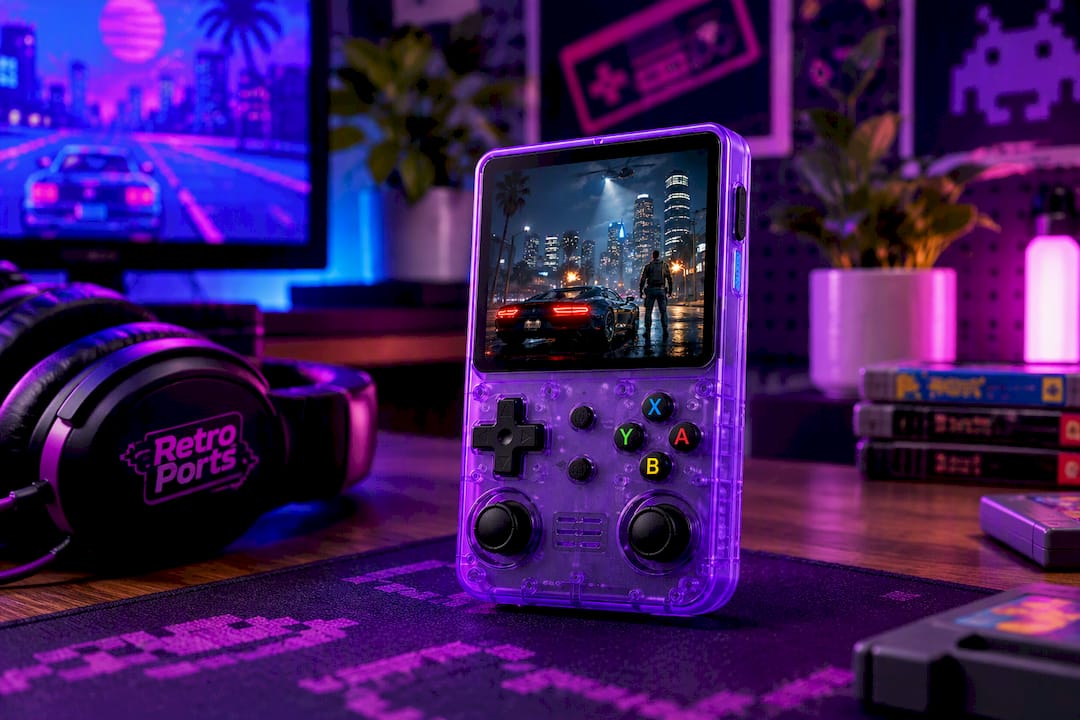
- Offline-first operation means no downloads, subscriptions, or setup between genres.
- A 3.5" IPS display and removable battery support extended sessions across multiple game types.
- U.S. warehouse shipping with a one-year warranty backs every unit.
| Feature | What it means for genre exploration |
|---|---|
| 15,000 preloaded games | Sample action, platformer, RPG, and puzzle titles without separate downloads |
| Offline-first | Play anywhere without a connection or account |
| 3.5" IPS display | Clear visuals for both fast-action and detail-heavy genres |
| Removable battery | Extended play across longer RPG or adventure sessions |
Parents who grew up on these genres can hand the same device to their kids without a setup process, and anyone curious about a specific era can jump straight from an arcade shooter to a 16-bit RPG on one screen. Check availability on the Retro Pulse product page.
FAQ
What are the different genres of retro games?
The main retro genres are action, platformer, adventure, shooter, puzzle, role-playing, sports and racing, fighting, simulation, and arcade. Each is defined by what the player does mechanically rather than by story or setting.
What are 20 different game genres?
Beyond the core ten retro categories, fragmentation over time produced subgenres like action-adventure, metroidvania, beat-’em-up, run-and-gun, visual novel, tactical RPG, rail shooter, survival horror, rhythm, and party games. A fuller survey of genres and subgenres shows how extensively the original categories have split.
What are the top 5 game genres?
By unit sales in the retro era, strategy and role-playing led with 19.7 million units in 1999, followed by action at 17.1 million, sports at 8.9 million, racing at 7.8 million, and shooting at 4.6 million. Those five categories dominated console libraries throughout the 1990s.
What are the top retro games of all time?
There’s no single official ranking, but titles widely treated as genre-defining include Super Mario Bros. for platforming, The Legend of Zelda for action-adventure, Tetris for puzzle, Street Fighter II for fighting, and Final Fantasy for RPGs. Each demonstrates the core mechanic its genre is built around rather than simply being an early release.
How can I play classic games across multiple retro genres today?
A curated offline handheld like Retro Pulse preloads thousands of titles across more than 20 systems, letting you move between genres without separate downloads or emulator setup. This approach works well for comparing mechanics directly, since every genre example is available on the same device.
Sources
- 1999 industry research (NPD) — sales by genre (cited via ESA-hosted PDF)
- Video game genre — Wikipedia
- Comicbook
- Henry Lowood — Thoughts on the computer game archive of the future (software preservation)