A curated retro game library is a small, deliberately chosen set of classic games picked for how much you will actually play them, not for how many systems or titles it covers. Focused libraries beat sprawling archives because they cut decision fatigue and put your best games front and center. The result is more time playing and less time scrolling menus, and the steps below show how to build one.
TL;DR:
- Building a curated library of 20 to 50 games focused on playability improves enjoyment and reduces decision fatigue compared to larger, less selective collections.
- Prioritize titles with responsive controls, fair difficulty, and session lengths that fit your available time to ensure ongoing engagement.
- Official reissues and curated collections are more reliable sources for access, as most historical games are no longer in active distribution.
- Regular pruning of unused or unplayed titles keeps the library relevant and prevents it from becoming overwhelming.
- Preloaded handheld devices like Retro Pulse offer a ready-to-play, legally sourced curated library across multiple systems that requires no setup.
Table of Contents
- 1. Themed Collections That Prove the Playability Rule
- 2. How to Build a Curated Retro Library Step by Step
- 3. A Simple Rubric for Choosing What Stays
- 4. Why Bloat Creeps in and What to Do About Disappearing Titles
- 5. How Retro Pulse Delivers an Instant Curated Library
- 6. Why Selectivity Beats Completeness
- 7. Get a Curated Library Without Building One Yourself
- Sources
- FAQ
1. Themed Collections That Prove the Playability Rule
A curated library works best when it is organized around a purpose, not a platform count. Instead of collecting every game a system ever released, group titles by why you would actually load them up on a Tuesday night.
- Platform essentials: one or two defining games per system, chosen for how they still feel today rather than how well they sold decades ago.
- Short-session favorites: arcade conversions and puzzle games built for five to ten minute bursts, ideal for commutes or study breaks.
- Genre micro-collections: a tight platformer set, a handful of RPG essentials, and a couple of arcade ports that hold up without a manual.
- Hidden gems: lesser-known titles that reward replay because of tight controls or a mechanic nobody else tried.
Some picks earn their spot through broad recognition. The Legend of Zelda: Ocarina of Time (1998) is widely cited by editorial consensus as one of the best games ever made and holds a 99/100 Metacritic score, which is why it anchors so many curated lists rather than being an obscure inclusion. Community-driven projects follow the same logic: the TopRoms collection deliberately skips exhaustive coverage in favor of a hand-picked set chosen for gameplay quality and significance across systems. That is the model worth copying: a few anchor titles everyone recognizes, filled out with games that earn a spot on merit rather than nostalgia alone.
Avoid the temptation to add a title just because it exists on a system you already have. A themed slot filled by a mediocre game is worse than an empty slot, because it adds friction the next time you are deciding what to play.
2. How to Build a Curated Retro Library Step by Step
Building a library that actually gets played is a process, not a one-time download spree. Follow a workflow that treats the collection as something you tend, not something you finish.
- Pick a target size first. A core library of 20 to 50 playable titles tends to produce more satisfaction than a massive one, since a trimmed set removes the decision paralysis that comes with hundreds of unplayed options, according to IGN’s curated collections coverage.
- Draft a candidate list by category. Sort possibilities into platform essentials, short-session picks, and genre favorites before you commit any of them to the final library.
- Test before you keep. Load each candidate and play it briefly, paying attention to how the controls feel and whether the core loop pulls you back in.
- Source legitimately. Favor legal reissues, official compilations, publisher-sanctioned collections, or a curated device, and skip anything that requires questionable downloads.
- Tag and organize. Use folders or metadata tags for genre, session length, and system, then arrange a rough launch order so you always know what to try next.
- Prune monthly. Remove anything untouched in the last month unless it is a deliberate slow-burn pick, and back up your saves and settings before making changes.
Pro Tip: Give every candidate a strict ten to fifteen minute trial focused on input response and how quickly the core loop hooks you; if it does not click in that window, it is not earning a permanent slot.
The pruning step is the one most collections skip, and it is the one that keeps a library useful for years instead of turning into a graveyard of good intentions. A monthly pass takes minutes and pays off every time you sit down to play instead of scroll.
3. A Simple Rubric for Choosing What Stays
Every candidate game can be judged against the same short checklist before it earns a permanent spot in your library.
- Controls and responsiveness: does the game react the instant you press a button, with no noticeable lag between input and action?
- Fair, learnable difficulty: can you make visible progress within a session or two, rather than bouncing off a wall of trial-and-error deaths?
- Session length that fits your life: does the game offer a satisfying stopping point in the time you actually have, whether that is ten minutes or an hour?
- Replayability: is there a reason to come back, whether that is randomized levels, a speedrun angle, or just a mechanic that stays fun on the fifth try?
- Availability as a tiebreaker: when two similar games are close in quality, favor the one that is easier to access legally and less likely to disappear from a storefront.
Industry commentary on the retro gaming resurgence backs this order of priorities directly: curated collections hold up best when they favor responsive controls and fair difficulty over historical importance alone, since a game nobody wants to touch is not doing its job no matter how significant it once was. Historical weight can break a tie between two similar games, but it should never override how a game actually plays in your hands today.
4. Why Bloat Creeps in and What to Do About Disappearing Titles
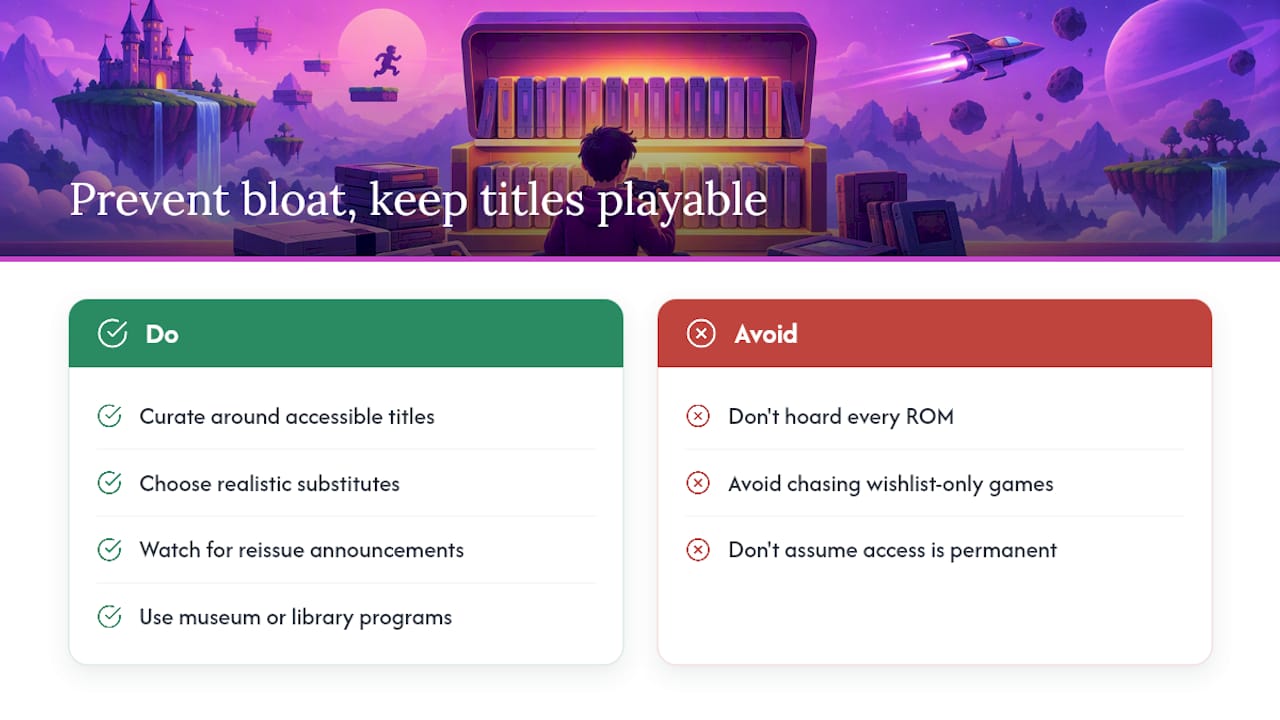
Library bloat happens gradually. One more ROM, one more bundle, one more “I’ll try it eventually” download, and soon your options list is longer than your available playtime will ever cover. The paradox is that more games usually means less playing, because every additional title adds another decision to make before you even start.
Only a small fraction of historical games remain in commercial distribution today, according to a preservation and availability analysis%20-%20Reply%20-%20Anonymous%202.pdf) that reviewed over 4,000 historical titles. That scarcity is a strong argument for building around what is actually accessible rather than chasing a wish list of games that may vanish from a storefront or never resurface at all.
When a specific title is out of reach, look for realistic substitutes instead of assuming access is permanent. Official compilations, publisher reissue packs, and museum or library programs are common, legally supported ways to experience classic games without depending on unstable digital storefronts. Watching for reissue announcements and treating a favorite as replaceable, rather than irreplaceable, keeps your curation flexible instead of frustrated.
5. How Retro Pulse Delivers an Instant Curated Library
A preloaded handheld gaming console can offer a curated library across more than 20 systems and work offline from the first power-on with no downloads or account setup. Features such as a 3.5-inch IPS display, real D-pad and twin sticks, and a removable battery support good controls and session-length priorities, while warranty coverage and local warehouse shipping can back the hardware.

For a reader who wants the playability-first approach without building a list from scratch, that preloaded curation is the shortcut: someone else already applied the same filter you would apply yourself.
6. Why Selectivity Beats Completeness
I keep coming back to the same lesson: a library of 30 games I actually play beats one of 3,000 I mostly ignore. Every time I have pruned a collection down to what genuinely earns replays, the games left standing get more attention, not less. Treat curation as a habit you revisit, not a project you finish once and forget.
— Sean
7. Get a Curated Library Without Building One Yourself
For readers who would rather start playing tonight than spend weeks testing candidates, Retro Pulse skips the sourcing and organizing steps entirely.
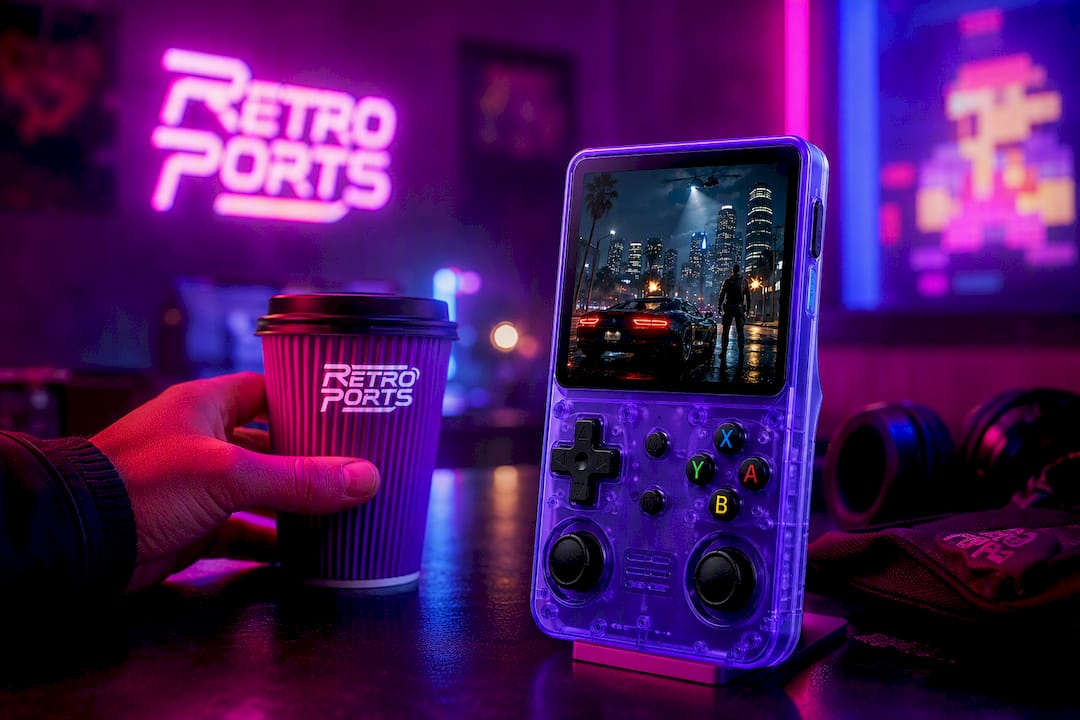
- It ships preloaded and ready to play the moment you turn it on, with no menus to configure first.
- The curated library already reflects the playability-first filter this guide walks through.
- A removable battery and portable build make it fit short sessions anywhere, not just at a desk.
Check availability on the Retro Pulse product page to see the current lineup and shipping details.
Sources
- Screen Rant — Zelda Ocarina of Time metacritic claim
- Wikipedia — Retro gaming
- IGN — Best retro game collections playlist
FAQ
What counts as a curated retro game library?
A curated retro game library is a deliberately limited set of classic games chosen for playability rather than completeness. It typically favors titles with responsive controls, fair difficulty, and strong replay value over an exhaustive archive of every game a system ever released.
How many games should a curated retro library include?
A core size of 20 to 50 playable titles tends to produce more satisfaction than a much larger collection, since a trimmed library reduces the friction of deciding what to play, based on editorial curation practices. Beyond that range, added titles often go untouched rather than adding real value.
Why are so many classic games hard to find legally?
Only about 13 percent of historical games remain in active commercial distribution, according to a preservation and availability study that reviewed thousands of titles. Rights issues and platform shutdowns are the main reasons, which is why compilations and official reissues are worth prioritizing when they exist.
What should I look for when picking games for a curated collection?
Prioritize responsive controls, difficulty that feels fair and learnable, and a session length that matches how you actually play. Availability and legal access are useful tiebreakers when two candidates are otherwise close in quality.
Is a preloaded device like Retro Pulse a legitimate way to get a curated library?
Yes, a preloaded handheld can deliver a curated library instantly without the sourcing and organizing work described in this guide. Retro Pulse, for example, ships with a curated selection across more than 20 systems and works offline from the first power-on.